How making alternative MUSIC SCALES for ESQ1] [LISTEN TO the pART SOUND SET for ESQ1] [ONE OCTAVE IN THIRTY ONE STEPS ] [MICROTONAL TOOLS TODAY ] [ GO TO NEXT PART OF THE P-ART PARADISE]
|
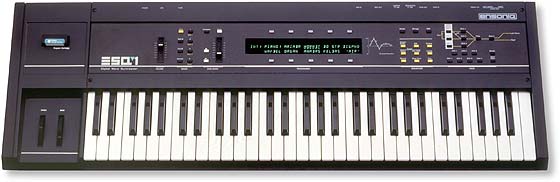
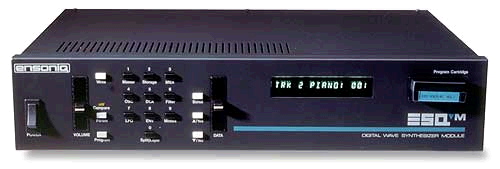
The double P-ART Sound Set for ESQ-1 / ESQ m (& SQ-80)
P A T
C H P
A R T MANUAL
|
by P-ART
Version 1.O (1991) Sound Set with PART Patch Manual Version 1.1 (1992) updated Sound Set with PART Manual Version 1.2 (1993) with revised PART Manual: General PART & Patch PART
Electronical Edition in PDF-format (2004) in HTM (2013)
COPYRIGHT Paper versions 1991,1992,1993 Electronical Edition in PDF format(2004)
No part of the PART Sound Set + PART Manual © 1993 / electronic version in PDF format ©2004 and these html pages may be copied, reproduced to any electronic medium or machine readable form without the written consent of Paul A.R.Timmermans, Belgium. All rights are reserved.
BOOKLET VERSIONFull free release here on this webpage (2013)
P A R T A
Performance Note: Please, don't forget to set the PITCH-BEND RANGE= + 01 on your ESQ-1/SQ-80 for a correct WHEEL-modulation of the PART- sounds.

Scroll down to bottom A1. CELLO* bowstick
Set A begins with a sound you don't find in any other ENSONIQ instrument including the SQ-1/SQ-2 (KS-32) and SD-1.
CELLO* excels by its raw and subtile simulation of a real playing cellist.
Remember: making a good sound is like composing a fine piece of music. First of all: time is money! It requires the limits of the internal capabilities of your instrument and it reflects most of all your musicality , your personal horizon, your musical fantasy and last but not least the musical intuition of the patchmaker. A good patch also depends on luck.
I don' believe that good patches are the mathematical result of sound-theoretical curves. It helps, but it is'nt the key!
CELLO* is a good example of this experience.
Some time ago I played and experimented with a real cello. Havings its sound in my subconscience I invented this cello on my synth.
I achieved the same richness in sound and the same pleasure using a bowstick when playing CELLO* on the ESQ-1. With CELLO* I feel and hear the bowhear sliding over the strings under each key that I hold down. It never reproduces the same streak or the same sound. This cellopatch is very real and extraordinary proper to the characterics of a celloplay:
'pluck' a key lovely and staccato,
or play legato.
Every time I am surprised by the close simularity to the cello, the variability of the sounddecay due to the ENV2 modulation in the FILTER and VOLUME pages (+ENV1 ) and to the modulation of LFO3 in the FORMANT2 waveform (OSC2).
>>>>> In combination with a clear PERCUSSION sound of the O.S. SOUNDPROCESS-disk for the Ensoniq MIRAGE sampler (in my case the MIRAGE-DSK) I play two instruments with the same fingers:
the xylophone of Mirage OR the cello of the PARTA soundset appearing by a fast or slow attack.
I'm enjoying the control of two instruments by fingertouch ON THE SAME KEYBOARD: the ESQ-1.
A2. BASJ CO bass(L) & flute (U) wheel= reverb
is a pretty double-bass(BASS) in the lower part of the keyboard and a swinging FLUTE in a jazzcombo(J CO) on the right available IN ONE WAVEFORM (SQR 2).
>>>> For more reverb, turn the WHEEL open.
A3. 'HARPU sounds only upper (without split)
This HARP is based on a single waveform, A HIDDEN ONE: # 49 . The most interesting aspect of this common Harp-sound is the mapping of the sound on the keyboard.
'HARP-U is programmed for the upper part of the keyboard ( C3-C6). The lower part is mute, without split-programming!
>>>>> If you like playing harp on all keys, change the OCT(+0)tuning to +2.
>>>>> If you only like the sound in the highest area( A4-C6), change to -2. Store it as "HARP in a free parkingplace.
A4. CLAVRD T2 in ENV4
refers to a rich sounding historical instrument . The CLAVICHORD is based on the NOISE2-waveform (OSC2) modulated by itself (sync=OSC1) and by ENV3 en ENV4.
The reverb is allowed by the MODE-function : CYC (ON).
>>>> If you like a tremendous BOUZOUKI, decrease the T2 in ENV 4 to about +22 : when playing short notes (staccato), you produce the tremolo on each string of the greek Bouzouki-lute.
Store as BUZUKI.
A5. KOOR 2 voice-MOD: ENV1
This CHILDREN'S CHOIR (VOICE2) is a 3-dimensional sound due to
* the special ENV-technique, modulating the voices (by ENV1) and
* the modulators in the FILTER-section: ENV3 and ENV4 !
Play with the left hand chords and a two finger melody in the right hand. Keep the music in the middle area.
>>>> Decreasing the levels ( L1,L2,L3) in ENV1, you reproduce other kinds of choir.
When decreasing the level to - 64, you listen to the RUSSIAN CHOIR. If this is yours, store this sound as RUSSY.
Read about envelope-modulation of the ESQ-1 oscillator in:
Jim GROTEs great article Formant Shifting.Transoniq Hacker #55 , January, 1990, p. 9.
A6. AMORGR timbre by CV-PEDAL
It's a TUTTI, based on A M.
You 're hearing the sound of a pipe organ, reverberating on the walls in a cathedral. CV-PEDAL controls the timbre-level. (See DC A1)
>>>> Change AM to SYNC and you play another very powerful organ. Store this sound as SY_ORG.
A7. PIP -VP volume: CV-PEDAL
This represents a PIPE-organ.
>>>> Use the CV-PEDAL to influence the overall volume .
A8. 'HISOR vibrato
is based on the same hidden waveform # 34(=WAVE033) in the 3 oscillators.
Don't expect to play 'HISOR in tune with other -normal tuned- sounds.
This patch has a little deviation (KBD): it sounds fine on its own but abnormal if you face this pitch-scaling with a layered normal-tuned flute or piano.
The subtle modulation (KBD,LFO1&3/ENV3) in the oscillators gives every played key - especially in the higher area- a charming vibrato,
typical for rich historical organs (HIS OR) in famous European churches.
A9. 'FLT CHR chorals ENV2 in DCA4
Play for instance a intimate choral (CHR) of Bach with the flute- organsound (FLT) that is based on the hidden waveform # 34 (one oscillator).
This sound excels by its purity and simplicity : one oscillator and a subtle NON-modulated sound.
The control of the final volume by ENV2 looks important.
'FLTCHR may be useful for melodic lines in all kinds of music styles.
A10. 'DESUZ bass(L) melody(R) without split
Hidden waveform # 63( WAVE062) gives the opportunity to play a transparant BASSline in the left hand and a pretty vibrated melody in the upper part of the keyboard, reminding of the optimistic vocals of Linda de Suza(DESUZ).
The pretty vibrato-sound is caused by the KBD-modulation of LFO1 in DCA1.
A11. MEZSAX sax(L) accordion (C5-C6)
expression by CV-PEDAL
Two instruments in two hands without split-function.
Because of its extremely slow and natural decay you play a lovely real SAXOPHONE in the lowest octaves (L: 1 finger) .
If you like, play legato on the right keyboard-side: ACCORDION lines or 3 notes-chords in the highest octave.
>>>> Expression could be added by CV-PEDAL (LFO2).
A12. BODEL sax wheel= expression
combines two sinewaves and one kick(!)waveform. BODEL is a tremendous SAX due to the realistic envelope and AM-modulation.
>>>> You can introduce more expression: increase the value of the wheel (+2) in OSC1.
A13. *MOOI* touch the keywork of the bass clarinet
This is a real (= ENV!) deep and warm BASS CLARINET - look at the tuning-modulation by KBD (-63) & KBD2 (+16)- in the lower part of the keyboard.
When you play the upper part with a light short touch , you are controlling a real REED. You hear the realistic imitation of the keywork.
>>>> If you prefer a more tiny clarinet, change the WHEEL to +63 in the OSC2 (= SQR2) .
A14. FGT*CL bassoon (L) clarinet (U)
This is a patch useful to play such pieces as the melody of the BolĒro of M.RAVEL, music themes in the style of GERSHWIN.
Or it might be possible to integrate FGT*CL in a Jazz section.
In the lower keys you may find the BASSOON(= Fagot/FG) while you play with the right hand CLARINET(CL). The formant-peaks are the result of the high RES(Q)values in the SQUARE waveform. The nasal timbre is influenced by the dynamic touch of the keywork.
A15. REED3 OSC3 + T1 of ENV4
The deepness of the rarely used REED-waveform is caused by the third (only used) oscillator in this patch modulated by ENV2. It enhances the nasal breathy sound .
>>>> If you like an ACCORDION in the right zone, slow down the attack (T1= +) of ENV4.
A16.'BS*FL bass(L) + flute (U) in a single oscillator
Play the hidden waveform # 63 (=062) as a strong acoustic bass(BS) ONLY in the lower part of the keyboard . The low bass is pronounced by doubling the sound (OSC1 en OSC3) and by doubling the KBD2-modulating on the amplitude.
The third oscillator ( in this case OSC2) is based on hiddenswaveform # 46(WAVE045) that produces a normal flute(FL) ONLY in the upper part of the keyboard .
A17. ' BASFL bass flute (L) + blanco (U)
This is a bass flute based on one oscillator with hidden waveform # 46. The low tuning level depends on the KBD-modulation(-53) .
The modulator of the DCA 1-level is KBD2(-24) and mutes the upper part of the keyboard.
A18. FLAUTO LFO
Waveform SQR2 in OSC 2 is accomplished by waveforms OCT+5 and SAW . The subtle LFO-modulations in the different oscillators produce the typical wind-rotation of a blowed TRAVERSO.
A19. 'ROMA MIDI-windcontroller
This is a typical MIDI-windcontroller sound . You can influence the timbre of the FRENCH HORN ( especially in the C2-C4 range):
see modulator PRESS (+11) in the FILTER-page (hidden wave #35).
Reed Brian ROST about using wind controllers with Ensoniq keyboards in Transoniq Hacker # 72, June, 1991, p. 12-13.
A20. FLUTDR drum (L) flute (R)
Surprise! This is not a layered patch!
The complexity of the envelopes ( ENV1+ENV3) in the VOLUME-page, the subtle use of LFO1, the influence of the velocity on the FILTER and the surrounding of a NOISE2-waveform on the double used SINE-waveform gives the FLUTE an extra realistic breathing approach.
In the lowest octave a soft DRUMnoise(DR) enhances the exclusive SNARE-feel into FLUTDR. You don't need any other patch or MIDI soundmapping. The ensemble is complete.
A21. CASTJ split with other sound
It's not easy to program a natural sounding CASTANET.
The NOISE 1, NOISE 3 and KICK-waveforms produce the complex sound: there is no pitch interval between the keys because of KBD2-modulation (-62) in the OSCpage.
>>>> If you don't reserve the total keyboard for CASTJ it's a splittable patch which is exciting in combination with ANDAL.
A22. ' ANDAL guitar(L) piccolo(U) without split
I've programmed several guitarsounds for the ESQ-1. The selected 'ANDALsound is exclusive. Remember: a good patch never works for ALL styles.
A 'good' patch is not only good by itself:
the aesthetical quality of a soundpatch is also determined by its position and functions in the musical context to which the patch is related. For example I have programmed other guitar-patches for the ESQ-1; they work very well as acoustical solo in a classical string-ensemble. Other guitarsounds work only well as accompaniment to ballads.
Classical GUITAR(OSC1) in the left side ( 3,5 octaves) and in the same patch (OSC2) a 'percussive' PICCOLO only in the highest (U) -octave.
>>>> The midzone(C3-C4) is deaf because of the incomplete hidden waveforms used in 'ANDAL, interesting for layers. (Look at patch # B39('MID).
The classic guitar is produced by waveform #63 (WAVE062).
You can hear the subtle piccolo (WAVE049) - reserved for the 1.5 octave upper keys - in the right corner of the stereofield (= panning). The acoustical guitar (ANDAL) located in the left side of the stereofield reminds me of the splendid FLAMENCO festival of Benalmadena in Andalousia (Spain).
>>>> ENV3 in the FILTERsection is responsable for the pitch and attack (play staccato and listen) and for the sustain (play legato and listen) of this amazing classical guitar.
A23. 'BALI upper half
Two oscillators with hidden waveform # 46 (WAVE045) affect only the upper half of the keyboard. The non-standard tuned scales (the oscillators are modulated by KBD2 and KBD) deliver different intervals between the keys. 'BALI is a realistic simulation of the traditional mallets, associated to the gamelan music of BALI.
>>>> Open the third DCA and in the lowest octave you find an extremely attractive ETHNIC guitar-ensemble of India .
>>>> Turn the amplitude of OSC1 and OSC2 OFF and you 'll get:
A24. 'INDIA keys C1-E2:tabla(L) sharadiya-vina (R)
This patch sounds only in the lowest area C1-E2!
How to play 'INDIA?
Play the rhythm pattern on the LOW TABLA:
use one finger of the left hand on key #1 and
with the right hand you play with a very picked light touch a fast staccato melody.
You hear also the strings of the SHARADIYA-VINA (Indian lute) : touch the keys with different independent fingers (right hand) in the same lowest keyboard area ( E1-E2) .
Two hands are controlling the complete Indian traditional ensemble based on a single waveform (hidden waveform # 54) on ONE octave of the keyboard.
A25. 9-T EP 9-equal temperament
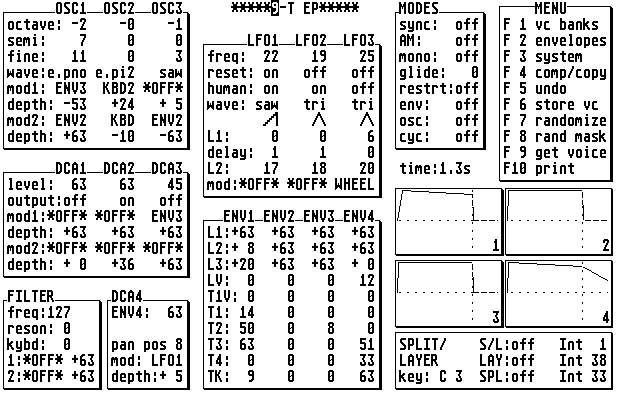
This DIGITAL PIANO(EP) is based on OSC2 = e.pno. 9-t E P is detuned to a new musical tone-SCALE: 9-tone scale.
If you ask for references to the normal chromatic scale (divided in 12 equal semitones): C4 (= key #37) of the 9-t EP- scale is the only one note that have the same pitch as C4 in the regular 12-tone scale. In 9-T EP the octaves are divided in NINE equal pitch intervals instead of normally 12 equal intervals.
Play a major sixth (C3-A3) and you hear a distance of one octave.Normally you need an interval of twelve half steps between C3 and C4. The distance D3-B3(!) and not D4 is one octave. If you play C3-Eb3 (standard = minor third ) -surprise- it's a major third that sounds!
If you play C-F, then you listen to a perfect fifth and not a perfect fourth.
The capital point however is that the 9-tone scale of 9-T EP is very suitable to improvise pianomusic. Believe me, it opens incredible new horizons.
Please, don't try to execute standard scores on the normal way with 9-T EP. Of course, you can try and hear the difference. Make fun!
A26. 24-T TR quarter-tones
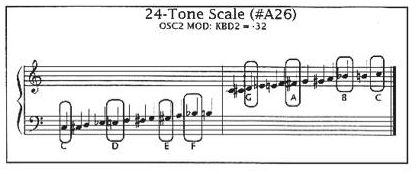
This is the interesting 24-tone scale to play QUARTER NOTES- music.
The TRUMPET (OSC2= SAW) is modulated by KBD2 (-32) .
The twelve half steps of the normal chromatic temperament are dispersed over two full octaves of the normal scaled keyboard.
Try to play the normal diatonic scale using the following keymap:
C2 E2 G#2 Bb2 D3 F#3 Bb3 C4
(=C3) (=D3) (=E3) (=F3) (=G3) (=A3) (=B3) (=C4)
You 'll never play BAD chords with this scale!!! When you play a cluster, there are only consonant harmonies and never dissonant notes in the chord.
To correct the little detuned upper key # 61 in this scale, I have increased a very little bit the frequence with KBD(+1) in OSC2.
A27. '6 T FL macrotuning: 6-tone scale
This fluty (FL)- patch is a 6-tone scale: from C3 (=C3) to F#3 (=C4).
Two octaves are compressed in one normal tempered octave! OSC2 of hidden waveform # 46 is modulated by KBD2 +50 and KBD+48 .
The incredibly high notes are required to mute the upper keys.
You play -with ease- music with 2 or 10 fingers, without knowledge of standard chordintervals or chordprogressions. Your music is always in perfect harmony. No matter how many fingers in the left and right hand you may use. Whichever intervals or clusters you play, there always is a deep very consonant music.
With '6-T FLpatch you can't play false notes because of the special intervals between the keys . Remember, all this is available on your ESQ-1 in one patch: '6 T FL.
A28. MABO pitchmodulation by KBD2 & KBD
reverb: T2 in ENV2 & ENV4 wheel: filter
With this mallet(MA) instrument you're traversing the jungle .
>>>> Do you like to stress more the BELLsound , increase the level of the filter with the WHEEL.
>>>> Do you like more reverb, increase the level of T2 in ENV2 and in ENV4.
>>>> This is a good sound for experiments with microtonal scales, described like above: KBD2 and KBD in OSC change the pitch ratio of the keys. Try and enjoy.
A29. 'INTER organ zones + pedalmodulation
Hidden waveform # 41(WAVE040) is used for a nice portable ORGAN.
The lower part of the keyboard is normally tuned . With a very soft attack you may distinguish - by ear - a very small but nicely increasing step.
The upper key area (#34-#61) is divided in small equally tempered chromatic steps within incomplete octaves due to the ENV4(!)- modulation of OSC1:
7 keys (#34 - #40):
key #34 repeats the tone of key #22(it's a A),#35= Bb,#36= B ...
8 keys (#41 - #48):
key #41 repeats the tone of key #24 (it's a B ) ....
8 keys (#49 - #56):
key #49 repeats the tone of key #25 (it's a C) ....
5 keys (#57 - #61):
key #57 repeats the tone of key # 9!(it's a low G#)....
Final question: is it possible to make MUSIC with this uncommitted sophisticated INTERpatch?
Of course! Ultimately, it is the musician who decides; he produces his music in this bizarre maze of keymap. Playing 'INTER it easy and sounds very nice!
Playing C5 gives a lower C than C4: strange but attractive.
Play music with two hands on the upper part of the keyboard. Encouter the new subtle world of incomplete octaves, caused by the upper-samples and wave-rests in multiwaveform # 41.
>>>> The ultimate 'clou' of this very excessive scaled patch is the CV-PEDAL function (or change pedal to WHEEL). With the pedal, new subharmonics and new subscales infiltrate OSC2 and OSC3 - same WAVE040 - modulated by ENV2, ENV3 and KBD.
>>>> Try other values of modulation.
Hundreds of variations can be STORED as new soundpatches.
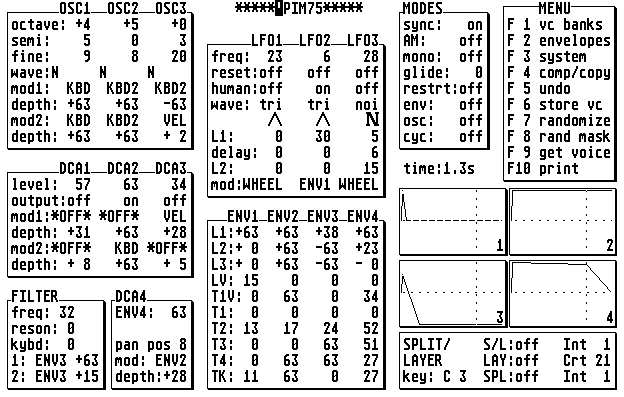
A30. 'PIM75 Arabic lute patch template
This ETHNIC LUTE OF ARAB is an intriguing patch useful for many exotic musicstyles. WAV074 in 'PIM75 is the highest hidden ESQ-1 waveform # 75 taken from the SQ-80 wavetable. Please, ignore the sound of the top-octave. Please, don't be picky with details. The basic frequency is strongly augmented by double KBD-modulation on the high octaved OSC1, synchronizing (SYNC) the highest OCT-tuning level (=+5!) and modulated by the double KBD2 (= + 63!).
>>>> Take the 75th hidden waveform in each oscillator of 'PIM75 as a wonderful starting point for changing the soundcolour, if you are using the sheetdata of new ESQ-1 programmed patches(available from 'third' companies and Transoniq Hacker). I discussed already this point of view in chapter III of my general manual: HIDDEN WAVEFORMS IN ESQ-1. (p.10)
However, scrolling through 75 waveforms in the three oscillators of the ESQ-1 may only be doing scrolling from high (074) to low (SAW). Please remember to save your created inter-patches because you can't scroll from the lower hidden numbers of waves to higher hidden waves!
A31. FINGER harp VEL2
is a HARPY patch (SQUARE waveform). The oscillator is completely guided by the velocity-curve (VEL2) which makes it possible to discover all pitches of the entire keyboard-range with one finger.
I consider this is a very obsessive patch; if you play for instance 3 notes, always in the same way, you'll hear a tremendous flexibility of pitches!
>>>> Experiment with other values in these two modulators of OSC1.
A32. 'FEELS sax L1 of ENV4 and loudness by VEL
Because the volume is controlled by a doubled full VEL-modulation on OSC3 ( hidden waveform # 63) this patch simulates a SAXOPHONE with an exceptive dynamic. With a soft touch you hear the sax a little bit; if you play harder, you 'll produce a louder sound. Listen to the keywork on the sax-body!
>>>> Don't start immediately the sax-sound. Look to L1 of ENV4. Change L1 a little bit to obtain the final volume.
A33. SENSY3 brass pitch-change by touch
Go to the hill and play BRASS.
First of all, feel very slowly the TOUCH(=velocity) of each key. With a finger on the same key, you'll play a nice line of brass!
C3 (key # 25): a soft touch produces Eb2(= key # 16!), a hard played C3 sounds like A3 , and so on. After playing for a while, you put down more fingers on your keyboard. Try and you'll enjoy conducting a polyfonic BRASS-ensemble. Each key produces a tone that differs from the normal note-position.
This means:
key # 25 = pitch of key # 18,
key # 29 = pitch of # 39 and
key # 32= pitch of # 30 (a large D minor instead of a perfect C-E-G).
One logical rule using SENSY 3:
on the lower keys you can't achieve the same frequency as on the upper keys. There is indeed a small progression of pitch from low to high!
The pitch of the SAW-waveform is modulated by VEL2(+25).
>>>> If you try to play with VEL2 = -25 or other negative values, it is necessary to increase the OCT-tuning level.
>>>> The reason for modulating the pitch with VEL2 instead of VEL is stricktly a musical decision. Try: with pitch-control by VEL, the keys you touch simultaneously in a normal chord, are sounding like BAD clusters instead of consonant intervals.
A34. CHIMES pitch modulation(R): L1 (slider) arpeggio
The 3 oscillators are tuned differently.
There is a small vibrato in the total CHIMES-patch.
The velocity (VEL2), the KBD-modulation and most of all the highly differently tuned oscillators (double SQR2 and one SINE) produce the sparkling sound of chimes and brings you into the right atmosphere .
Because there is no real tremolo ( freq. of LFO1= 0!), changing L1 of LFO 1 influences the pitch level and not the envelope!
Go to the LFO1-page, play a sustained arpeggio of 3 notes with your right hand and at the same time change the L1 with the dataslider in the left hand. Increasing to +63, the chordnotes drop. When decreasing to 0 you'll arrive to higher notes in modulation.
>>>> If you like a plain BELL-sound, turn OSC1 and OSC3 off and change the LFO1 modulating OSC2(it's a SINEwave!).
Holding L1 ( +44), decrease the delay (+44) of L1 and the level of L2(+44) to zero. You 'll obtain a lovely clean BELL-keyboard.
A35. THEN Glockenspiel Touch the keys! Resonance
A very nice sounding GLOCKENSPIEL.
It is not the colour by itself but the particular resonance of each key that impresses. A soft, low touch has a very realistic resonance. A hard touch provokes a long bright resonance. This patch has been programmed by induction and is the result of a lucky day! You cannot program such patch from sheet to obtain this sound. THEN is due to
* the interaction of the FILTER-modulators LFO1 and ENV3;
* the influence particulary of ENV1 on the oscillators;
* the subtle LFOmodulation and
* the weight of the different levels of volume in the lower and upper part of the keyboard.
Play this 3-dimensional patch: it sounds reserved and sensible. The audience won't believe you that this music doesn't originate from acoustical instruments but is an electronic sound !
A36. ETERIC soundeffect LFO3 + ENV (OSC1&2)
The last four sounds of the first PARTA- soundset for ESQ-1 are sounding totally different from normal patches. It is hard to describe the very ethereal characteristics of ETERIC based on waveforms (PULSE and PULSE2) of the two first oscillators . The delay of the LFO3-start and the long release of pitch induce the undefinable development of the sound-envelope. The slow emerging of this sound enhances the undirectional perspective of ETERIC. Something strange is about to happen, but when??
The fascinating complexity of this sound is due
* to the ENV-modulations of OSC1 and 2 , DCA and FILTER
* and to the SYNC-function .
ETERIC provides a good background-patch for movies.
A37. AMAZON attack + wheel
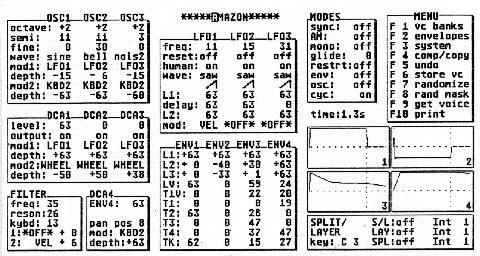
AMAZON drops the listener into the middle of the Amazon forest: singing and flying birds, dangerous fauna and unknown flora. You enter this mysterious world of AMAZON easily by attacking strongly the hold down key. You can leave this dangerous world with a soft touch. Strange things are likely to happen !
The 3 waveforms are SINE, BELL and NOISE2. The LFO1 is modulated by the VEL-parameter.
>>>> If you like a less dangerous Amazone, move the WHEEL full up and listen to the moving birds flying away from the clearings in the Amazone forest.
>>>>Try to discover your own amazing world by alterating the data of the WHEEL-modulation in the different DCAs. Store it as AMAZON.
A38. SINEN soundeffect T2(ENV2) / KBD (OSC2)
It is difficult to describe this fascinating sound. It sounds a bit like warm drops in a magic cave. The patch is named SINEN because the SINE-waveform is used twice.
The two oscillators are modulated similarly. There is a very high tuned SINE, modulated by KBD: the reference to a normally tuned music instrument is completelly lost . Look especially at the ENV2-modulation : all levels(L) and times(T)= 0, except L1=+63.
The subtle charme of SINEN is achieved by the fine tuning of OSC2 (+3) and the long release time (T4 = 49). So, the waves emerge and disappear slowly .
You are absorbed by the atmosphere of love and emotion when playing SINEN. I have succesfully used this patch at the begin and end of the music which I composed for a play in Brussels.
>>>> Take your time to explore a more personal SINEN. Increase T2 of ENV2 or increase the attack in the FILTER-page: ENV2(+63).
A39. ELEKGO timbre
ELEKGO is a typically electronic sound(=ELEK) Ö la Varäse and Xenakis.
For this program I have selected OSC2( KICK!) and OSC3 (NOISE1). The oscillators are deviating widely from the standard scale due to the double used KDB2.
ELEKGO invites to listen to the texture and to the evolution of this TIMBRE in the highest range of the keyboard .
A40. BLANCO mapping sounds
Sometimes I need this mute soundpatch for those MIDI-sounds which I like more in the low or high range instead of the entire range of the keyboard.
>>>> If you don't use BLANCO, propose several suggestions to save here -instead of BLANCO- one of your favourite variations of the pART- patches.
click and go to> P A R T B



© P-ART