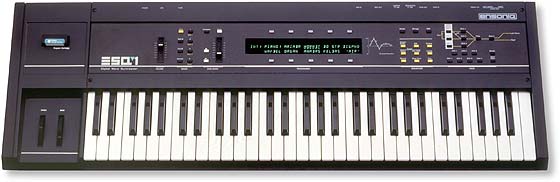
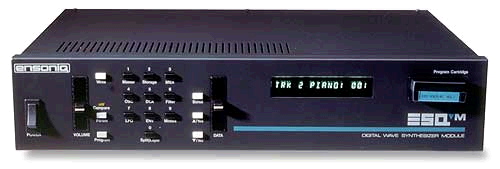
INNOVATIVE GENERAL APPROACH
TO 80 PATCHES FROM THE DOUBLE P-ART SOUND SET FOR ESQ1/ESQ1m/SQ80

Scroll down to bottom Click and go to the > PATCH PART MANUAL
|
The double P-ART Sound Set for ESQ-1 / ESQ m (& SQ-80)
G E N E R A L P
A R T MANUAL |
by P-ART
Version 1.O (1991) Sound Set with PART Patch Manual Version 1.1 (1992) updated Sound Set with PART Manual Version 1.2 (1993) with revised PART Manual:
General PART & Patch PART
Electronical Edition in PDF-format (2004) in HTM (2013)
COPYRIGHT Paper versions 1991,1992,1993 Electronical Edition in PDF format(2004) webversion (2013)
No part of the PART Sound Set + PART Manual © 1993 / electronic version in PDF format ©2004 and these html pages may be copied, reproduced to any electronic medium or machine readable form
without the written consent of Paul A.R.Timmermans, Belgium. All rights are reserved.
BOOKLET VERSIONFull free release here on this webpage (2013)
GENERAL INTRODUCTION TO ESQ-1 PATCHING
The quality and originality of a new synthesizersound depends on the interaction between
- the musical intentions of the patch maker (sounddesigner)
- his developmental stage and musical intuition
and
- the environment within which this sound has to be operational.
Programming sounds is an ART. It's like composing a piece of music.
The sound programmer has to compose a not yet released patch. Every sound configuration is the result of an aesthetical choice between
- his personal (musical) inspirations and needs and
- the physical possibilities of the musical tools (architecture of musical hardware and software/ waveforms and parameters).
Remember: there are never "good" sounds which are aesthetically for everybody , or good enough for all music styles.
Having this in mind, the P A R T sounds for the ESQ-1 are a wonderful set for the musician who likes to explore undiscovered dimensions of this "oldfashioned" MIDI-instrument of the late eigthies.
For the musician who loves the raw base sound of the ENSONIC ESQ-1 or SQ-80, I promise a facelift to the ENSONIC instrument. A new release-like soundmachine will surface.
A good synthesizer should be a musical instrument that enables the gifted musician to develop full knowledge and skills, just like mastering an artisanal instrument.
The double PART-soundset for the ESQ-1 includes various aspects of the ART of programming patches.
All rules or tricks - ever published by TRANSONIC HACKER- have been included.
Set A of 40 ESQ-1 sounds requires set B of 40 other patches to complete the full spectrum of hidden possibilities in the ESQ-1(SQ-80). The PART-set 'touches' your unexplored personal world.
The new soundpatches enhance the fully creative musictool that the ESQ-1 still incorporates.
In the PART- patches for ESQ-1 you will be surprized by the great flexibility of the expressivity range, by the hidden waveforms and last but not least by the possibility of making alternate tuning scales:
all of them are much easier available in the ESQ-1 (and SQ-80) than synthesizers like the SQ-1, SQ-2 or KS-32. Just verify for yourself.
The new double PART - set for the ESQ-1 (SQ-80) is not a sum of still pictures. Contrary, all ESQ-1-patches represent a dynamic entity. This soundset was'nt developed as 'closed' units - where you are forced to buy each new sound from any third party company or person.
THE USER doesn't have to be A SLAVE.
The patches however have been designed as WORKSHOPS,i.e. as a real CLINIC to open new musical perspectives ...
IF THE ESQ-1 USER INTENDS TO SCULPTURE SOUNDS, he needs the extended PART-PATCH-MANUAL that has been developed as a integrate part of the ART of programming ESQ-1-patches.
The PART-set is accompanied by an extensive PATCH MANUAL.
The PART-guide is meant as a wonderful tool to help everybody who likes to re-discover new incredible features of the ESQ1.
Using the manual, you can change and store many alternatives or variations of the PART- patches. The double soundset (40+40) can be easily augmented to more than eigthy patches. It won't be hard to store for example 140 patches: 79 based on set A and 61 derived from set B.
I. U N E X P L O R E D S I D E S OF THE ESQ-1/SQ-80
1. SOUND PATCHING
Do you understand the basics of your sound-machine ?
Don't forget the existing architecture of the ESQ-1 (and SQ-80).
There are 3 voice-generators, each based on one of the regular 32 (and more hidden!) WAVEFORMS, with a separate TUNING LEVEL and a specific VOLUME level (finishing in a global amplitude).
The FILTER-section determines the degree of colouring in the waveforms.
Each parameter can be influenced by two modulators, creating variation of the pitch, vibrato, time-process, attack, reverb, 'spacing' of the sound.... All this can be controlled
by your ESQ-1(SQ-80) very easily!
The ESQs and SQ80s of Ensoniq still have plenty of unexplored sides of the synthesized world like audio-frequency amplitude modulation and filtermodulation which don't exist in the newer Ensoniq synths VFX, SQ-1/2 and KS-32. The A.M. function, available on the ESQ-1 and SQ-80, accepts two inputs!
John Mc DANIEL has explored the harmonic spectra with amplitude modulation on the ESQ-1 and the SQ-80 in Transoniq Hacker, Issue # 38, August, 1988, p. 9-11.
Kirk SLINKARD has explained the amplitude modulation of ESQ-1 for MIDI- woodwinds in Transoniq Hacker, Issue # 68, Febr.,1991, p. 20-21.
On the Master page, setting the PITCH BEND to HELD mode allows the keyboard to bend only those notes which are actually being held down by fingers, while ignoring notes that are being held by the sustain pedal. (Sam MIMS, Transoniq Hacker, # 74 , August, 1991, p. 13-14).
Put your favourite patch into the Compare buffer ("c") and change anyone of the values of this patch. Your patch is temporarily stored in this buffer. ( B. WHITLOCK, Sound Shuffling on the ESQ-1, T H # 61, Juli, 1990, p. 11).
Read in Transoniq Hacker about reverberating (T H #77, Nov.,1991, p. 18-20 and #70, April, 1991, p. 22), echoes(T H # 46, April, 1989,p. 9), stereo panning (T H #60, Juni, 1990), splits (T H # 31, Januar, 1988) and Control Voltage PEDAL ( T H # 46, April 1989, p. 15-16).
4. CONTEMPORARY LIMITATIONS OF THE ESQ-1 (SQ-80)
The ESQ-1 incorporates many useful MIDI-features to satisfy the wishes of contemporary electronic musicians.
Two contemporary limitations may arise:
First, the lack of sufficient multitimbral voices may be solved cheaply by adding a secondhand ESQ-1, the rack mount version ESQ-1 M, Yamaha QY10 (the MIDI-pocket, no bigger than a VHS tape), or other inexpensive soundmodule. The ESQ-1 has full OVERFLOW possibility of the MIDI-data, to augment the original 8-note polyphony.
The soundquality represents a secondary problem because the ESQ-1 includes the warmth of hybrid (analog/digital) music, in compared to the clean cool digital sound.
Use either the APHEX Enhancer, ROLAND EH-50, DBX296 Spectral Enhancer or DOLBY Spectral Processor 740 to enhance the soundquality of your synth.
If you like to add contemporary effects (ambient sound), run your ESQ-12/SQ-80 through an inexpensive effects processor: ALESIS QUADRAVERB, BOSS SE-50, ZOOM 9002 or, why not, the ENSONIQ DP/4.
II. THE PA R T OF P R O G R A M M I N G P A T C H E S
1. FLEXIBLE APPROACH: TAKE ANOTHER DOOR TO COME IN
It is important to maintain a flexible approach. Different points of view may be integrated in your programming:
You can start from a FAVOURITE soundpatch
OR from any sound you meet in your soundbank
OR you select intentionally a totally different patch as profile of the master-template.
When starting from a DRUMpatch to initiate the digits from a soundsheet, you may perhaps find THE original new FLUTE-wave envelope which you were looking for so long
OR don't indicate immediately the appropriate waveform(s) of the intended patch on the soundsheet.
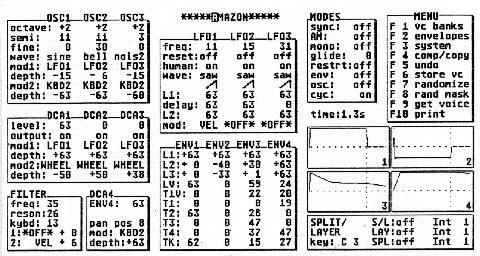
Suppose. We start from the soundsheet of AMAZON, a patch of the PARTB set.
Please don't put in the values as a slave! Search for flexible inputs.
Don't start from the top of the soundsheet. By changing the OSC-page you loose too fast the existing tuning level and soundcolours of the used waveforms. Changing waveforms at the beginning of a sound program have a major influence on the entire appearance of the soundpatch.
Reading the soundsheet, the startposition to a new patch should be
* the ENV-page
* OR the FILTER-page
* OR the LFO-page
and finally introduce the major waveforms and modulators in the OSC-page.
P.S.
To start again on the same patch, switch to another patch in the sound bank, then modify ONE value up or down and RETURN to your selected patch.
2. INTER-PATCHES
When using the flexible method, you'll discover several useful inter-patches before you arrive to the final point.
Instead of making a decision whether this sound is a really good one, don't hesitate to store the INTER-patch. Don't spend time or energy to find out a new exciting not yet released patch-NAME, because your MUSICAL mind is trying to sculpture SOUNDS, not to find compact words for every patch.
Store 'stupid' interpatch-names by moving up and down the dataslider coming to 1, 2 or more letters, symbols of digits f.E. "B'Y3".
When classifying new patches into soundbanks, I tend to select usually a simple, raw, not yet finished patch (interpatch) instead of a very polished, elaborated sound. The END-PATCH is, of course, the end of a complicated process but unfortunately it misses the sparkling spirit of some raw INTERpatches.
3. PARKING PLACES
Make the internal bank of your ESQ-1 free for new inter-patches. Before starting, make space in the internal soundbank or take used or empty locations in the ESQ-1 RAM sound cartridge. Check out whether you have at least a double row of 5 parking spaces free (= the full DISPLAY of a 10 sounds-page). The best way is working with a totally free internal bank of 40 empty spaces. The oscillators are turned off.
Do name this free patch spaces blank or ____ : this no-name is the empty place. This makes it easy to focus your mind creating new sounds without interrupting the work of programming sounds. This is a way to protect existing favourite sounds which you don't want to lose in any case by unpredicted manipulations in the existing soundbank.
Rember the general note:
If you like to store and select out your inter-patches, use a computer bankloader- and editor program for the ESQ-1 (see listing of available software above, p. G5).
4. INDUCTION
Read (again) your ESQ-1 manual and try, listen to your patches, read again, try again! That's the good way of induction.
Reading books on acoustics (about the embouchure of a wind instrument, the dynamic envelope of a pianosound ...) is the right thing to do, although it will never be enough.
The best way is to believe your ears. Make yourself distinct sounds, variations or nuances of sounds: experimentally. Don't believe theoretical values or figures.
Believe in induction!
In the PART-soundset, the conclusions about scaling volume and pitch intervals dispersed over the entire keyboard-range, originate from practical use of my ears modulating oscillators and the volume-page.
5. EASY WAY
Don't make the sculpturing sounds too complex.
For example: turn two of the 3DCAs off while focusing on the 'behaviour' of one audible oscillator. This makes it easy to listen to specific little changes of values in the LFO, filter or some oscillators.
6. JOKE
To leave a blind alley or a cliché, try the blind way: change the value by moving the dataslider sometimes slow and at other moments fast up or down, blind -a while- through the black bottoms, stop, change from one page to an other (FILTER, DCA, ENV, LFO ...) and blind again. Store some inter-patches. Don't forget once and again to switch between the ten soft switches above and under the program-display.
Surprises guaranteed!
III. H I D D E N W A V E F O R M S IN THE E S Q-1
The highest regular waveform on your ESQ-1 is the 32th wave OCT+5. Transoniq Hacker (Issue # 54, December 1989 and #60, June, 90) has mentioned how to access 43 additional waveforms in the ESQ-1. The Phantom Waveforms story goes about the 75th highest (hidden) waveform in the SQ-80 (= the upgraded ESQ-1): put the 80/160 RAM- storage soundcartridge from your ESQ1 in the slot of a SQ-80, store this 75th waveform (called DRUMwave) from the SQ80 in your ESQ-1 soundcartridge, and finally copy this SQ-patch in the internal soundbank of your ESQ-1.
Attention: This trick is only possible by the latest available O.S. upgrade-versions 3.4 or 3.5 of the ESQ-1.
About the numbers of the oscillator waveforms:
1. Waveform # 64 is indicated as WAV063 in the OSC-page of your ESQ-1 because WAVE # 0 refers to SAW (= the first waveform).
2. You can't scroll from low to higher numbers of hidden waveforms in your ESQ-1. Remember this limitation: you can only change from WAV074 to WAV032, from high to low.
Once I have experimented with wrong loaded events in my ESQ-1: blank spaces, unusual codes or digits in the soundbank display of my ESQ-1. In the oscillators-PAGE appeared very high # of HIDDEN WAVEFORMS, f.E. the 215th (OSC1) , the 195th (OSC2) and 129th waveform (OSC3)!!!! Of course, the TAPE-events (the TAPE input) were not compatible with the normal ESQ-1 format : it was a sequence-datastream, saved on a Roland MC-202 Micro Composer, stored on datacassette and then loaded in the ESQ-1. These very high hidden waveforms in the ESQ-1 produce "handicapped" sounds and incomplete keymaps (f.e. soundgaps between C2 and F3): not so practical in the sense of normal synth music, except for those who want to make inventive music pieces with unusual sounds or surprising effects. Some ' marked patches of the double PART-soundset use waveforms, which sound clean and nice over the total keyboard.
Other '-sounds from the PART set are multi split-patches (for example sounds # A22 and 'ANDAL # A29 'INTER) due to the incompleted waveforms. The patchnames in the PART- banks beginning with the special ' mark refer to ESQ-1 sounds based on hidden waveforms located above the regular waveform #32 (=OCT+5). The ' -patches work on the hidden waveforms and parts of multiwaves above or behind the 32 'normal' waveforms of your ESQ-1. Consequently, I recommand the ESQ-1 with O.S. version 3.4 or 3.5 to use these ' patches. The ' patches do not work exactly as programmed for the SQ-80 or ESQ-1 with O.S. lower than 3.4. On the other side, the owner of a ESQ-1 with O.S. lower than 3.4 can be surprised by new particular effects caused by the ROM-waveforms in his ESQ-1. He can adjust these ' patches alternating with one of the 32 normal waveforms.
IV. M I C R O T O N A L M U S I C ON THE E S Q-1/SQ-80
Temperament is the system of tuning in which intervals are "tempered" (slightly lessened or enlarged) away from their "natural" or "pure" form. There is contemporary interest in other tuning scales than the twelve-tone equal temperament for keyboards. A basic guide to alternate scales (= temperaments) on synths is TUNING IN (Temperaments and Microtuning using Synthesizers) by Scott R.WILKINSON published in 1988 by Hal Leonard Books. However, Wilkinson did'nt mention the strong quality of the ESQ-1/SQ-80 in this matter! Yes, you don't even need a VFX or SD synthesizer to make Quarter-tone music.
I would like to explain new ways for various tuning scales by modulating the full keyboard range of the ESQ-1 without calibrating individual keys. In this last case I recommand DICK LORDs alternate O.S. for the MIRAGE sampler or the tuning tables for the newer ENSONIQ EPS+.
Pitch bend modulation is a common method to vary the individual pitch of the ESQ-1 keys you play. Comments and tables of values of pitch control of the ESQ-1 were included in articles published by TRANSONIQ HACKER. Read Microtonality and Just Intonation on the ESQ-1 in Transoniq Hackers Issues # 73 (Juli, 1991, p. 13-14) and # 64 (October, 1990, p. 15-16). It seems very difficult to program maps - pseudo pitch tables (Transoniq Hacker, 1992, August, p.9) - for the newer ENSONIQ synths: SQ-1, SQ-2 and KS-32. Making alternate scales on the ESQ1 shouldn't be a time consuming job. It is easy to change, listen and control instantly the result.
You don't even have to make difficult calculations on paper or computer. Believe your ears and make a choice for the most musical solution.
Wendy CARLOS discussed her new released album "Switched-on Bach " in Back to Bach of KEYBOARD (August, 1992). She mentioned her difficulties to store and to use several alternate scales or to swap between different alternate tuning scales within the same composition (Brandenburg Three). Strange enough, Wendy Carlos was looking for fast solutions for downloading and switching tuning scales on the actual and best equipped synthesizers but the YAMAHA SY77 has just two user tunings.
If you like fast access to different tuning scales without loosing time, then use the good old ESQ-1. In this instrument you may store and practice up to 40 internal tuning scales. Without loading and losing time, the tone-scale of the ESQ-1patch is always integrated IN the soundprogram itself. If you like more then 40 scales, take a ESQ-1 sounds RAM- cartridge. Theoretically, you have instant access to at most 200 alternate scales using the 160 sounds RAM-cartridge! Isn't this great?
In the PART-set there are a few such patches integrated.
The trick of microtonal scales on the ESQ-1/SQ-80 is to find the relationship between the OSC-modulating and the pitch intervals.
1. Increasing or decreasing only the KBD-modulation of the OSC-pitch does affect a small impact on the intervals between the keys.
KBD + 63 : the tuning level is high;
KBD - 63 : the tuning level is low.
2. There are micro pitch intervals and there are macro-scales. When experimenting with a single KB2-modulator for the OSC-tuning (increasing KBD2 to +63), the pitch intervals become bigger than normal (= macrotonal scale).
When decreasing KBD2 of a oscillator in the OSC-page tot -63, the pitch level of the keys become closer to each others as in the regular way (= microtonal scale).
3. Stretching or compressing of pitchintervals by KBD and KBD2 (MOD.) don't result everytime in equal distance between the keys.
There are other increasing and decreasing levels for KBD- than for KBD2-modulation of the oscillator. Read your ESQ-1 manual to see again the characteristic curves from -63 to +63 for KBD- or KBD2-modulation.
There are a few combinations:
only one modulator: KBD
or KBD2
adding a second modulator:
KBD and KBD
KBD2 and KBD2
KBD and KBD2
4. It is possible to come out to the same tone scale using different ways.
For example: 14-tone scale: 3 ways of OSC-modulation by
* only KBD - 43
* KBD - 63 and KBD + 28
* KBD +32 and KBD2 + 32
5. For each microtonal scale you have to adjust the final pitch level (octave, semi, fine) in the OSC-page to guarantee the sound and musicality of the used patch / sound configuration.
6. When mixing the KBD/KBD2 modulation in two or three oscillators or in combination with ENVelope-modulation in the oscillator-page, the sound should be very complicated: sometimes strange and attractive patches, many times the result may be very bad.
The basics for the following microtonal scales on ESQ-1 (SQ-80) relate to scaling the pitch (= tuning of the oscillator) by KBD2- and/or KBD-modulation of 9-T EP (patch # A25), 24-T TR (patch # A26) and '6-T FL (patch #A27) in the PART-set.
When programming on one single oscillator of the ESQ-1/ SQ-80, I have selected musically the following macrotonal scales:
4-tone, 6-tone, 7-tone, 8-tone, 9-tone, 10-tone, 11-tone scales.
KBD2 (only OSC2 of 9-T EP is on)
+ 63 6-tone scale C3 - F#3 = one octave.
- 12 15-tone scale C3 - Eb4 = one octave
- 32 14-tone scale C3 - D4 = one octave
- 63 360-tone scale !!! extremely small intervals: C3 on key #1= C1
D3 on key #61= C6
this is ± unisono. This trick is always used in untuned drumpatches!
KBD2 & KBD
00 00 normal equal tempered 12-tone scale, OF COURSE.
+ 16 - 63 normal equal tempered 12-tone scale
- 24 + 10 normal equal tempered 12-tone scale
+ 24 - 10 9-tone scale (=soundpatch # A25: 9-T EP): it's pretty to play normal chords and hear other tones.
Only C4 is the same pitch as C4 in standard scale.
- 63 - 63 56 (!) tones in 1 octave
REVERSED : deep E1= high C
high C6= low C
Rootnote for standard tuning: middle G3 = G
- 63 + 63 45-tone scale: 1 octave is stretched from C2 to A5!
- 32 - 57 42-tone scale! very small(micro) pitch-progression from low to high keys.
The diatonic standard notes of this keymap are
C1- G1- C#2- F2- C3- G3- D4 F#4
(C D E F G A B C)
- 20 - 31 21-tone scale: C2 - G2 - C3- A3
( C - E - G - C)
- 30 - 31 17-tone scale (C3 - F4 = one octave)
- 63 + 12 You need more keys as the standard distance to the octave becomes the progression of only 1 regular seminote interval.
+ 12 + 12 10-tone scale: interesting scale layered with normal tuned 12-tone scale
which are based on clear ESQ-1 waveforms like 4OCTS-wave.
+ 63 - 63 7-tone scale: C3 - G3 = one octave
+ 46 + 63 6-tone scale C - F# = one octave
+ 32 + 32 14-tone scale C3- G4 = 1 octave (D3= pitch D3) (decrease OCT-tuning level to -2)
KBD2 & KBD2
+ 48 + 48 5-tone scale (adjust OCT-tuning 0 to -2)
+ 63 + 48 7-tone scale sounds very well but different if you play classic intervals (chords); experiments are permitted with LAYERING a normal tuned scale-patch!
- 63 + 58 4-tone scale ( C - E = one octave)
+ adjust the OCT-tuning level 0 to -2
KBD
- 63 16-tone scale C3 - F4= one octave
- 55 15-tone scale C3 - E3 (+ adjust OCT-tune 0 to +1)
- 43 14-tone scale C3 - D3 (+ adjust OCT-tune 0 to +1)
- 20 13-tone scale C3 - C#3 (+ adjust OCT-tune 0 to +1)
+ adjust the OCTAVE-tuning level to -1
+ adjust the ENV4-page in the 9-T EP patch: decrease TK from +63 to +33 and increase a little bit T4 from +33 to +38
+ if you wish, layer this new sound(scale) with soundpatch #4 CLVD (normally tuned):
this combination seems impossible but gives a totally new merged sound.
00 standard 12-tone equal tempered scale, OF COURSE!
+ 20 11-tone-scale C3 - B3
+ 43 10-tone scale (+ adjust OCT-tune to -1)
KBD & KBD
- 63 - 63 24 tone-scale (QUARTER TONES): you will never play bad chords.
+ adjust OCT-tuning level to +2
Sound #A26: 24-T TR is based on this scale.
- 63 - 49 21-tone scale C3 - A4 = one octave!
+ adjust OCT-tuning level to +2 (or +1)
Without problem, it's possible to make good sounding music based on classic chord intervals: the pitch resultats of this 'normal' chord play of course are extremely different.
- 63 - 31 19-tone scale C3 - G4 = one octave!
+ adjust OCT-tuning level tot +2 (or +1)
+ classic chords intervals musically are enjoyable butr completely different.
- 63 - 24 18-tone-scale C3 - F#4 = one octave (OCT-tune +2)
- 63 - 14 17-tone-scale C3 - F4 = one octave (OCT-tune +2)
- 63 + 14 15-tone-scale C3 - Gb4 = one octave (OCT-tune +2)
- 63 + 28 14-tone-scale C3 - D3 = one octave (OCT-tune +2)
- 63 + 42 13- tone-scale C3 - C#4 = one octave (OCT-tune +2)
+ 63 + 16 9- tone-scale C3 - A3 = one octave (OCT-tune +2)
- 63 + 42 13- tone-scale C3 - C#4 = one octave (OCT-tune -1)
+ 63 + 63 8-tone scale
+ adjust OCT-tuning level to -2 or -31.
You'll play acceptable sounding samples on the keyboard.
Experiment by yourself different tuning scales! Make FUN in this fascinating world of micro- and macro-tuning. Building meaningful microtonal scales on the ESQ-1 is easier as on many contemporary synthesizers and samplers.The architecture of the ESQ-1 offers the opportunity to produce quickly microtonal scales.
Some of the new patches in the double set P ART are interesting base voices to create microtonal music (for example: MABO sound #A28). Other patches of the double PART- set are based on the higher described modulation in the OSCILLATOR-page (for example: MEET ME #B22 and 'TUNY #B37).
In many cases of macro tuning, the range of the voice over the keyboard is TWO or more octaves smaller than a normal 61-keyboard. Of course, some of this KBD- and KBD2-modulations can be applied to normal patches : piano, organ, strings, percussion ...
Starting from patches with at least one free modulator in one OSC-page you may develop your own microtuned scales. Read the possibilities on the table. Don't forget : it's easier to listen to the microtuning effect when working on a single open oscillator once a time. The end-patch of course can be based on several OSCs. To achieve a meaningful microtuning patch using the three oscillators, is a masterpiece build on chance.
V. VOLUME SCALING
First of all, volume scaling of the ESQ-1 patch is adjustable by KBD & KBD2-modulation of the FILTER.
The influence of KBD & KBD2 in the DCA-page of the ESQ-1 (SQ-80) of course depends more or less on the level (63 or 0) of DCA.
Doubling KBD- or KBD2-modulation of a DCA can be very useful for patching the hidden waveforms (Chapter III).
If the DCA-level is + 63, the volume can be modulated (scaled) by
KBD
+ 63 increases the volume gradually from low keys to high keys
- 63 decreases the volume gradually from low keys to higher keys
KBD2 & KBD2
+ 63 + 63 the 3 UPPER octaves only are audible: increases the volume from C3 to C6 in crescendo
- 63 - 63 the 3 LOWER octaves only are audible: decreases the volume from C1 to C4 (= decrescendo)
KBD2 & KBD
+ 63 + 63 the UPPER half of the keyboard: crescendo to C6
+ 63 - 63 only the 2,5 top octaves are audible
- 63 - 63 only the 2,5 lowest octaves are audible: loudest = C1 decreasing to the middle
- 58 + 14 only the lowest four octaves are audible C1 to C5: same loudness from C1 to C4; decreases the volume to inaudible in the 4th octave (C4-C5).
If you set the DCA-level to 0, the patch is turned out over the entire keyboard.
- 58 + 63 decreases the volume from low to middle (C1- C4)
Enjoy yourself experimenting with the values of this KBD- & KBD2-modulation in the DCA-page of one, two or three oscillator(s). It should be possible to pronounce the selected sound in the lower or upper part of the keyboard. For instance, you can get the bass in the lower area (left hand), the flute in the highest octave overlapping with an other patch (f.e. strings) in the upper keyboard (a LAYERED patch).
Remember:
Volume scaling has also to do with the modified tuning range of the modulated waveforms. The macro-steps of macrotonal scales make the voice-range smaller: the lowest and highest keys will be mute. Some bad sounding keys (due to aliasing) can be deselected by KBD or KBD2-modulating the volume of some keyboard areas. This feature could be an advantage in terms of combining voices and creating multisplits!
Depending on if there are gaps in the keymap of some hidden waves (for example WAVE045 and WAVE048), it should be fascinating to experiment with volume scaling and multisplits. Look to patches #39 ('MID) and '40 ('BSORG) of the PARTB soundset.
Click and go to
Patch manual A Patch manual B
BIO-NOTE about P-ART on the rear of the original GENERAL PART booklet 1991-1993
Paul A. R. Timmermans (° 1950, Belgium) is a college education training lector in ultimate adoration for music, arts and MIDI. He has written many articles about contemporary music and music education in several music (education) journals and magazins. Then years agoo, he released four pieces of acoustical experimental compositions on his first LP (Whitout Title). Paul Timmermans has produced several avantgarde performances. Recently he is fascinated by the art of sound programming and the multimedia world, always focused on sound and music.
La Séance Beethoven;
Squash Project / Musical Glass Installation;
Anthology (Record Box: graphical, literary works, musical projects, "Silence" record and musical sarcophagos);
Music for a Ritual Dance (Piano Music);
"Voyage to Civita" (Music for a Play in Brussels);
"The Body Talks Music" (Audiovisual Production).
Timmermans loves to disjoint the limits of classic music (Microtonal Music on ESQ-1) and to bring the rich sounding acoustical and fascinating digital world close together in many new projects (Acoustami Digitali di Parti), compositions for piano (Ethnical Harmony for Midified Grand Piano) and for MIDI-instruments (The World After).
INSTRUMENTAL EQUIPMENT
* ENSONIQ ESQ-1 synthesizer, ENSONIQ MIRAGE sampler, CASIO digital wind controller DH-100, Yahama QY10 pocketstation and Roland KR-4500 digital piano
* GULBRANSEN K4-MIDIfied German GRAND PIANO (RÖNISCH) linked at one ATARI 1040 ST using music notation software "ENCORE" (PASSPORT) for composing and storing piano works
* A SECOND ATARI 1040 ST COMPUTER with hard disk, PC- and MAC emulation, one printer HP 500 DJ for printing music, and many alternate music software
* INDIAN TABLA, ASIAN LUTE, ARABIC TRUMPET, MEXICAN FLUTES, SMALL PERCUSSION INSTRUMENTS, BELLS from all over the world and many "NATURAL" ACOUSTIC OBJECTS for experimental music.




© P-ART [Back to order page ] [Go to GM-Classification of the P-ART sounds] [Microtuning on ESQ1]