Michel WAISVISZ†
Scroll down
The first place where I met Michel WAISVISZ (NL) with his fascinating Musical Hands conducting his "Black Box Ensemble" was El Dorado (Antwerp, Sept. 1993). Click on Distance.mov for the exclusive videofragment from Michel Waisvisz' opening performance.
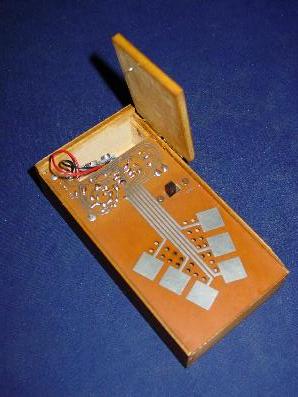
At most I love Waisvisz' innovation: the crackle box. I still regret that I could never find or buy this innovative thumb synthesizer. [Happy news August 2002: I take over the crackle box from Eppo van Straten (NL).]
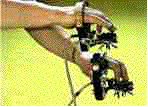
In the meanwhile "The Hands" has become the major instrument of Michel Waisvisz. It consists of small sensors and keys sticked on his fingers. By moving his arms, fingers and hands, the performer controls an entire electronic orchestra. Michel Waisvisz has played several concerts with his "Hands" in Europe, USA and Japan. (YOUTUBE: http://www.youtube.com/watch?v=SIfumZa2TKY)
Michel Waisvisz was director of STEIM Foundation (Amsterdam), an international forum for artists working in electronic music, live performance and new musical interfaces. STEIM (<click) is a international research and development centre for new instruments for music and visual arts.A few years ago, the Russian pioneer Leon THEREMIN visited STEIM and played "The Hands" of Michel Waisvisz. Michel's father has built the ThermenVox, the starting point for his 16 year old son Michel to develop new alternative electronic instruments. `
In June 2008, I was astonished by the news about Michel Waisvisz' dead.
P-ART
Michel WAISVISZ
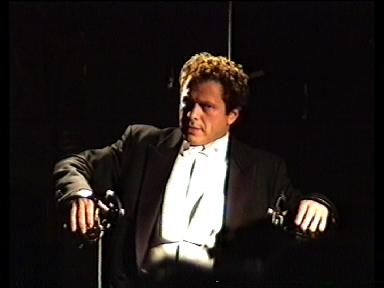
Digital Photo©P-ART 25/9/93 Antwerp
Click on my picture: MOV file starts. Enjoy the compilation video fragment from his opening performance at EL DORADA, Antwerp (1993) © video P-ART
My Musical Hands My Artistic Statement
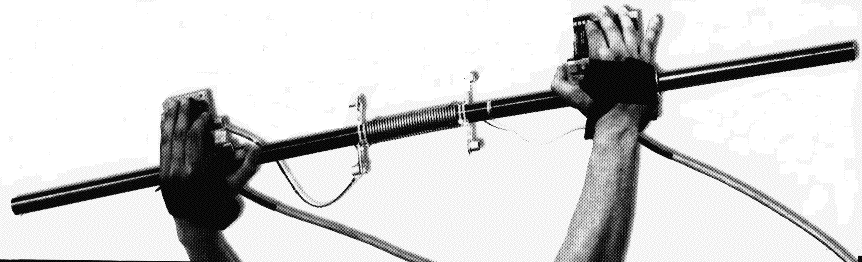
I used The Hands in concert for the first time in 1984 at The Concertgebouw of Amsterdam. The instrument consists of a number of sensors and keys, mounted on two small keyboards that are attached to the players hands. The combination of many different sensors to capture the movements of the hands, the fingers and the arms make "The Hands" are still one of the most refined and musical MIDI-controllers.
We have rebuilt and reprogrammed The Hands many times. The Hands II are linked to a vast variety of MIDI-instruments: Yamaha DX7's, 802's, TX7's, SY99's, Emu samplers and STEIM's software products Lick Machine, Sam and LiSa (<click for INFO) and more recently also STEIM's visual performance program Image/ine, an image sampler/manipulator also to be used by what I see as the image performer of the near future. To translate the sensor information into MIDI, a small computer is worn on the back of the performer. This computer The SensorLab was programmable so that for each work a unique relationship between the performers gestures and the musical output can be programmed. The improvements consisted of a single wooden frame as the main body for attaching the various sensors, better components and a more reliable wiring-system. Also the software was rewritten completely using the new Spider- programming-system. I'm still using this version of The Hands.
However we have started at STEIM the development of The Hands III. "TAM TAM" (The Spirit of the Digital Djembé) is a performance that I did for the first time in Nagoya (Japan), July 1997. I have played "The Hands" during hundreds of concerts in many different countries and circumstances. After 12 years I felt the need to look back. Not with a nostalgic eye but with an exploring ear. As a physical reference for, and against "The Hands" I choose one of the oldest instruments in the world and started learning to play it: the Djembé - the talking drum from Africa. Playing both instruments during one concert inferred a controversial awareness of historical versus phenomenological presence in the players mind. Another notable fact was that the acoustic sound qualities of the Djembé enrich the electronic sounds; in a way electronics cannot enrich the sound of the Djembé.
Michel WAISVISZ
The Legacy of The Hands
Although STEIM ceased its activities as an organisation in 2020, Michel Waisvisz's pioneering instrument The Hands continues to occupy an important place in the history of digital musical instruments. Through the Michel Waisvisz Archive, Li-MA, exhibitions, scholarly research and recent tribute events such as Digital Care: An Evening of the Hands, his work remains an enduring source of inspiration for artists, performers and instrument designers exploring the expressive relationship between gesture, technology and sound.
Further information: Li-MA: Digital Care - An Evening of the Hands · V2_: The Evening of the Hands · Sonic Acts: Michel Waisvisz - Touched by Sound
http://www.steim.org/steim/
Scroll down to read more information or go back to top The crackle box Historical Note (2026)
The Crackle Box (Kraakdoos), developed by Michel Waisvisz and Geert Hamelberg at STEIM during the 1970s, is considered one of the earliest touch-controlled electronic musical instruments. By making the performer's body an active part of the electronic circuit, it introduced an entirely new relationship between gesture, touch and sound. Its pioneering concept continues to influence experimental instrument design and live electronic performance today.
In 2002, P-ART acquired an original Crackle Box from Dutch sound artist Eppo van Straten. It remains part of the P-ART collection and represents one of the milestones in the history of experimental electronic musical instruments.
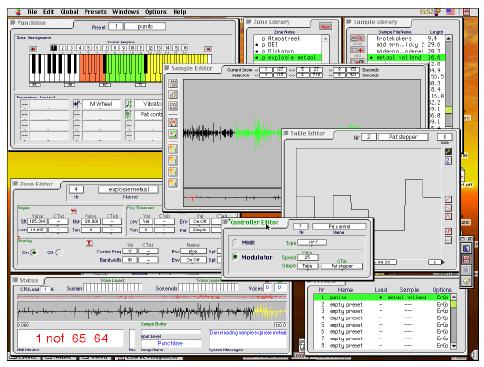
of Frank Baldé and Michel Waisvisz (STEIM) LiSa is a real-time audio manipulation environment for MAC. It turns the Mac into a versatile audiosampling player, able to generate up to 64 voices, only limited by the internal memory of the computer. LiSa gives the MIDI-musician access to all perform features of a sampling player and it offers a variety of algorithms for processing the sampled sound.
Homepage STEIM:http://www.steim.org/steim/
Historical Note (2026)
LiSa (Live Sampling) was developed at STEIM by Michel Waisvisz and Frank Baldé as a pioneering real-time environment for live sampling and interactive sound manipulation. It became an essential component of Michel Waisvisz's performances with The Hands and influenced a generation of live electronic musicians.
Although STEIM officially ceased its activities in 2020, LiSa remains an important historical milestone in the evolution of live electronic performance, interactive musical instruments and digital sound processing. Today it survives mainly through documentation, archives and academic research rather than as an actively maintained software environment.
LINKS
Archived Crackle Box page (Web Archive)
Li-MA Archive
Original Kraakdoos schematics (educational use)
Deutsches Museum – Crackle Box