Ethnic Instrumental Page

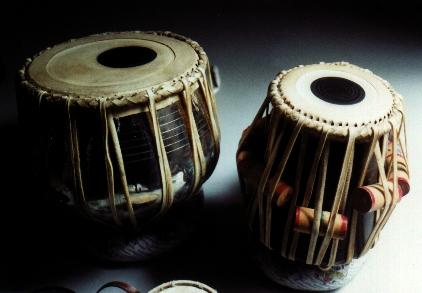
My DUGGI / bayan (Left Hand) and TABLA / dayan (R H)
Click here and listen to the sound of tabla + duggi (bass drum). Its a very short MP3 - excerpt from Bob Becker's performance on the NEXUS' CD. In this contemporary music piece PALTA (1981), the tabla set is the solo instrument playing improvised variations on several rhythmic themes.
Click here and listen to an other small MP3- excerpt and enjoy the different sounds played on the tabla surface.
Note that the experience of tabla music needs a long entrance and can't be evoked by short samples.
click>TECHNIQUES
click>RECOMMANDED SOURCES
Compared to other musical cultures, the Indian music world has few (click >) ideophones, sets of tone bars laid across a frame and struck with mallets. The fine drumming techniques provide a rhythmical answer to the drone of the Indian tunes.
Originated from Northern India, the tabla is a pair of drums differing in shape, size and pitch. The tabla is played with the right hand, the left beats on the duggi. (Both drums about 25 centimeters high.) The base of the drum has a slightly larger diameter than the top. The tabla is made from a round block of sheesham wood, hollowed out from inside.The 'left hand' drum (bayan) is a hemispherical bowl shaped drum made of polished copper, brass, bronze, or clay. Like the dayan, a composite membrane covers the bayan's open end.
The body of the drum is formed by three layers of skin. The bottom skin stretches over the entire head, then a second layer with a circular cut-out, the third top skin having a cut-out of an even larger diameter than the middle skin, so that there is a thick treble layer of skin around the periphery only. The centre of the head is covered with a thin film of smooth blak paste mixed from mango powder, boiled rice and tamarind juice which lends the tabla the fine muted sound for the rhythmical accompaniment of the sitar (si= three; tar=string). The modern sitar has seven strings plucked with a plectrum worn on the index finger. The resonator of the sitar is made of wood or from a gourd cut in the direction of the kernels, the belly made of thin wood.
Tekiyans are used for supporting tabla and duggi to avoid movement. Gaddians (top cushions) are filled with cotton. The Hathorie is a small hammer made of brass and nickelplated and is used for tuning tabla and duggi. When a stoke is given from top downwards, the sound should be raised usable for the adjustment of upto 3 notes. Half note difference can be adjusted on top by hammer stroke given on the top ring hole points.

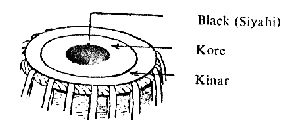 To produce notes
on tabla point are fixed on the top of tabla :
To produce notes
on tabla point are fixed on the top of tabla :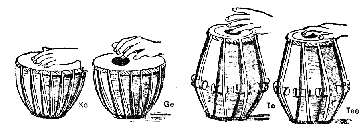
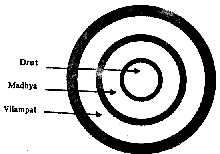 The three types
of LAY (= speed, or regular movement to complete a circle in
a definite time) are: Madhya Lay (medium); Drut Lay
(fast); Vilambit Lay (slow).
The three types
of LAY (= speed, or regular movement to complete a circle in
a definite time) are: Madhya Lay (medium); Drut Lay
(fast); Vilambit Lay (slow).
RECOMMANDED SOURCES
TABLA
VEERAN WALI BHAWAN, TABLA, for beginners (Vol.1) and Advanced (Vol.2) published by Pankaj Publications - Cambridge Book depot, 3, Regal Building, New Delhi. Revised print. Originally printed in 1977.
DAVID COURTNEY, Fundamentals of Tabla. 293 pp. Available via: http://www.amazon.com/
LINK: http://chandrakantha.com/articles/indian_music/tabla.html
INDIAN MUSIC
B.CHAITANYA DEVA, Musical Instruments of India. Available via: http://www.amazon.com/
David COURTNEY, MODES AND SCALES IN INDIAN MUSIC. Web page in: http://chandrakantha.com/articles/indian_music/swar.html
MP3 files of ACTUAL INDIAN CHARTS:
http://genres.mp3.com/music/world_folk/world_traditions/asian/indian/
Amjad Sabir has released interesting INSTRUCTIONAL DVDs about East Indian Music and especially about "Learn Tabla and Harmonium at Home". Titles and notes appear on the screen while following the instructions to learn these wonderful indian instruments. Click> http://www.sabirmusic.com/
MusicAnd@P.Timmermans
E-mail: MusicAnd(< click)
 ATELIER:
EXOTIC TRIP 1: hand-drumming
ATELIER:
EXOTIC TRIP 1: hand-drummingto the ETHNIC INSTRUMENTS-INDEX
Graphical pics and examples from the Tabla Book 1&2 are only used for promoting the Pankaj Publications© without commercial purpose. The short sound extracts on this
Thanks to Eugène Sciarone (Eindhoven, NL) who flied to Calcutta in the early eighties: he came back with an original tabla set for me, guide and music included.