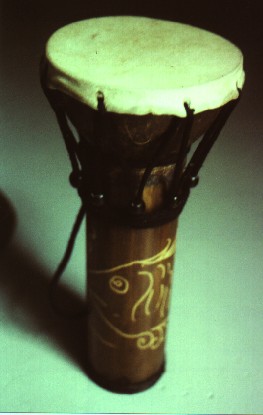
 Ethnic handdrum
1.
Take this exotic handdrum in your hand.
First, tick with your fingers softly and then harder. Hit the
surface with your whole hand. Alternate your hands touching the
skin. You can try putting your handdrum on a surface and experience
the different resonance of sound.
Produce a nice rhythm.
Why does the drum sound good?
What kind of wood is the handdrum made
of?
Observe the wooden frame. This exotic
handdrum isn't originated from a mountain village. How
do you perceive it? What has the woodcut artist sculptured in
the wooden handdrum?
2.
Observe now the cord-mechanism around the upper part of the
handdrum.
Experiment with the cord-knots aside the stretched skin.
Adjust other knots to stretch more or less. So you influence
the TUNING of the drum-membrane. Experiment with other tunings.
3.
Take the drums in your hands or hold
it in your lap. Or, put them on the floor: listen to the resonance.
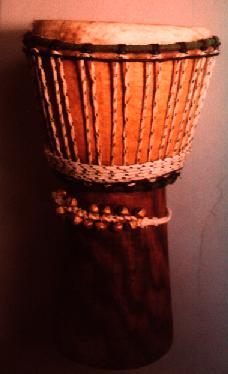
Explore the musicality
of the djembe-skin e.g. with your nails.
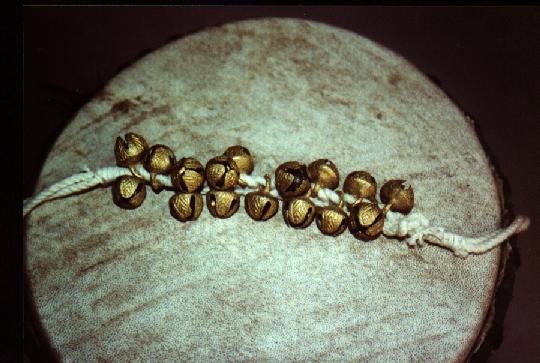
Compare the handdrum with for instance
the pottery - drum (found in Mexico, India, etc.) or a djembe
( Burkina Fasso and other regions of West Africa).
Explore and study on which parametres
(aspects) the exotic small drums can differ. Look at the bayan
of the TABLA
drumset (< click):
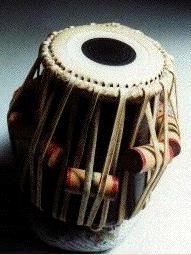
 Observe
the original drum and drumstick made in Kenya (double side surface
-all around antelope-skin).
Observe
the original drum and drumstick made in Kenya (double side surface
-all around antelope-skin).
What kind of function deals a little
drum like the handdrum (on
top of this page) in an ETHNIC SET
of instruments?
Write down your observations, and discuss
with your group or your tutor.
4.
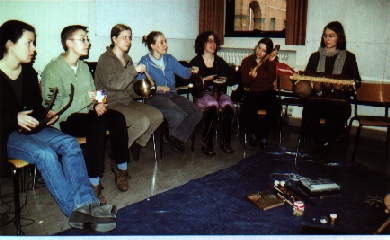 Sit
down on the floor or move and shake your body (like a native),
feel the beat or search for a spontaneous rhythm pattern on your
handdrum. Let your colleagues or partners answer and vary the
continuous rhythm with their ethnic instruments.
Sit
down on the floor or move and shake your body (like a native),
feel the beat or search for a spontaneous rhythm pattern on your
handdrum. Let your colleagues or partners answer and vary the
continuous rhythm with their ethnic instruments.