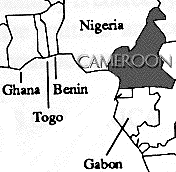
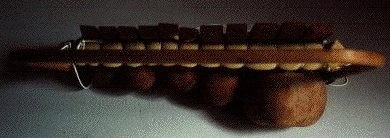
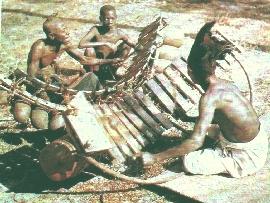
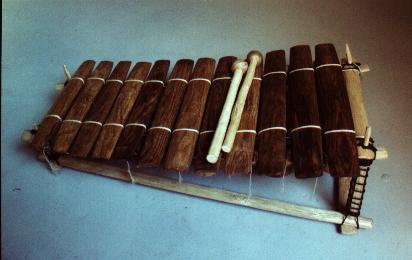
Ethnic Instrumental Page The Xylophone / Balaphone / Marimba With two large wooden sticks on the 'laptop' of the African music culture, weddings are accompagnied in Sud-Cameroon In West Africa, there is a completely different ideophone tradition associated with griots (< click) and hunters, the music of the balaphone.
I bought the 'laptop' of the balaphones (see picture above) from the Sud-Cameroon tribe "éton". Full of happiness, all membres of the village prepare themselves for the procession and accompany the newly weds to their home on the sharp and high percussive tunes of the 'wedding' balaphone.
The amplifiers of the African balaphone
When you translate the word "Xylophone" from Greek to English it means "wooden (= xylon) sound". The native xylophone is one of the most ancient instruments in the world. The xylophone consists of tuned wooden bars supported in their nodal point of vibrations. This percussion instrument comes in different shapes and varies considerably in size.
The mountainous and forested Guinea is the province of the balaphone.
The West African balaphone is both percussive and melodic. This xylophone has many musical relatives around the world. The charming and exotic sound of the gamelan ensemble (in Thailand, Indonesia etc.) is dominated by the percussive sound of metallaphones and xylophones. The tune is carried by the ringing tones of the 'sarons' developed from xylophones more than 1000 years ago. The highest pitched bar is the 'saron panerus' while the lowest is the 'saron barung'.
The xylophone from the gamelan ensemble is called 'gambang' while the African xylophone has a tribe-typical name in Oeganda (akadinda), in Ethiopia (ambira), in Mali (bala), in Sudan (balafo), in Congo (dimba) and in the Bantu tribes of soutern Africa (mbila).
Originally the 'marimba' is brought from the African continent to Latin America, where today the instrument is considered a folk instrument, especially in Guatemala where it has been the national instrument for several hundred years. There are amplifying tone-hole of different lenght for all bars.
Marimba's from Central America and other xylophones have resonators in the form of long tubes with cradle-shaped boxes under the bars.
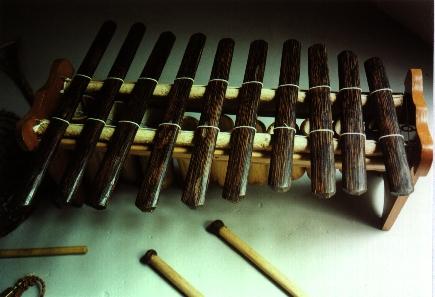
African balaphones have resonators in the form of carefully selected dried gourd for each bar. The air volume in the gourd amplifies the vibrations of the bar. A hole is cut in the gourd and covered with the protective skin of spider eggs, the skin vibrating in concord with the bar lending the tone a sharper tone colour.
< The famous Keletigui Diabaté (Mali) attaches the calabashe resonators (=amplifiers) on a new balaphone.
My balaphon from Burkina Fasso (= earlier Upper-Volta, on top of Benin etc.) The balaphone is the oldest Griot instruments. The bala are hit with mallets that are made from hard wood.
When you hit the key, the sound is amplified by the calabash gourd that lies beneath each note. The membranes, covering the tiny hole in each gourd, are usually made from cigarette papers. The papers give the gourds a buzzing timbre.
RECOMMENDED:
* Ernst Klaus SCHNEIDER, Vom Umgang mit dem Fremden. Materialienband: Kursmodelle Musik Sekundarstufe II. Frankfurt/M, Diesterweg Verlag, 1996.
* Percussionist Evelyn GLENNIE (UK) delves into her giant box of xylophones and uncovers their stories: she presents a monthly feature in 'Music Review' on BBC World Service. Her website: www.evelyn.co.uk.
MusicAnd@P.Timmermans
E-mail: MusicAnd(< click) GO TO THE EXOTIC TRIPS in the ATELIER
to the ETHNIC INSTRUMENTS-INDEX
All rights reserved © P.Timmermans MusicAnd Photos © P.Timmermans This page belongs to: http://www.multimania.com/musicand