The Kora (Cora) and Lyra
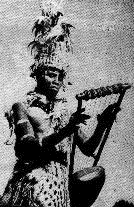
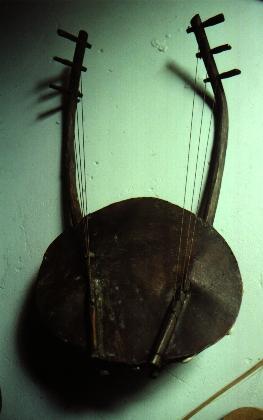
The Lyra The single LYRA (player of Kenya) The double lyra (West Africa) Explore the similarity of this harp-like tone-scale and the sanza-keys. Click >SANZA
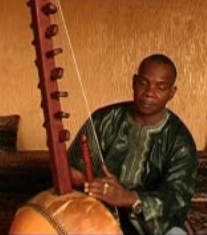
Foday Musa Suso |
The kora, the ngoni and the balaphone (< click) are the three melody instruments of the Manding griot. All three instruments are found throughout the Mandinka world, but each has its region of dominance. The kora rules in Gambia, and the worlds best kora players are found along the meandering river that bisects that country. In Mali, the ngoni is king, and if you ask a Malian griot singer what instrument she prefers to work with when developing repertoire, she will almost surely pick the ngoni.
The Gambia has more kora players than Mali, Guinea and Senegal. In these countries they sometimes use the French spelling "cora". In mali and Guinea, kora players usually don't play and sing at the same time. In Senegal and the Gambia, it is common for kora players to also sing. The style is faster and louder than in other countries of West Africa.
The Mandinka Griot Doday Musa SUSO, the son of an important kora player, mastered 111 traditional songs -many of which are ten or more hours long - by the time he was 18. SUSO travelled more as 18 years through Africa, America and Europe, promoting the Griot music culture. He created new works for the Griot repertoire and collaborated for instance with jazz saxophonist Pharoah SANDERS, Bill Laswell, and with minimalist composer Philip GLASS.
Griots, often seen as a kind of African sorcerer, are traditionally travelling minstrels.
Griots sing many verions of the epic song "SUNJATA. French ethnomusicologist Tolia NIKIPROWETZKY asserts: "The African musicians who correspond most closely to blues singers are griots of the tribes of northwest Africa, from those areas where many thousands of people were taken as slaves".
The Griot tradition is strongest in areas of West Africa that are primarily Islamic but include christian communities and membres of traditional tribal religions.
The rol of griots is ambivalent. Griots are walking libraries, chiefs repositoring the history of their region; she are musicians, their presence was essentially required at all celebrations and rituals; admired as virtuosic singers and instrumentalists, the griot caste, however, is low in the social hierarchy. The great Griots are well paid for their services. Some griots are sedentary: in this case, the griot will also work at another job: finsherman, farmer, etc.). Other griots are itinerants, and travelling from village to another, and their reputation and income can vary considerably.
The kora / cora is a harp-like instrument and a notched bridge similar to that of a lute or guitar. It sounds like a harp, but its playing style is closer to flamenco guitar.
The kora's body is made from a calabash gourd cut in half and partially covered with cow skin. Traditionally, there are twenty-one playing strings plucked by the thumb and forefinger of each hand. The remaining fingers grip the two vertical hand posts. For strings, players use fishing line which provides a brillant tone and is easily obtained at the local market. Twenty-one anchor strings attach the playing strings to an iron ring bored through the base of the kora's hardwood neck. The player tunes the kora by moving the leather rings to achieve the appropriate tension on each string. Kora players use a variety of tunings. The tunings of the kora vary from region to region.The kora is a sweet-sounding, 21-stringed harp-lute, the hardest to play of all African instruments. Each kora has his own sound, and each plaeyer chooses his own range. the kora is tuned by moving the hide rings on the instrument's neck up and down, which changes the tension an pitch of the strings.
The training of kora players , exclusively oral, necessitates a lenghty apprenticeship under the direction of a teacher., most often the father, or an uncle.
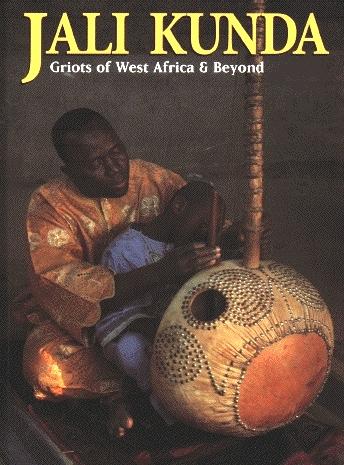
Jali KUNDA: " When your teacher feels that you are ready, then you must take his kora and go. I travelled through five villages. Playing and singing, I received gifts and money. It was my teacher's responsability to build my first kora; it took him a month-and-a-half. First, he gathered all of the materials that he needed to build the instrument - this included the calabash, cowhide, an the pole is made of keno (hardwood). As a Master of the kora, the oldests of the village listened to me. At the end they shaked hands with the teacher. If you don't play well you must continue your studies. Young Griots study the balaphone in the same way I studied the kora, by going and living with a teacher. I'm afraid fewer Griots are learning the kora. The children of Griot families go to school instead of studying Griot tradition."
RECOMMANDED SOURCES:
Jali KUNDA,Griots of West Africa & Beyond. Book and Compact Disc by Ellipsis Arts © 1996. Traditional African Griot Music and contemporary collaborations with Philip Glass, Pharoah Sanders, Buill Laswell & Foday Musa Suso. Track 2 & 7 : SUNJATA. While the words remain basically the same, instruments, accompaniments and tunings vary from one region to another.
Web site about African music and instruments : http://www.coraconnection.com
Listen to kora player TOUMANI DIABATE, The Mande variations. World circuit/ Harmonia Mundi (CD 2008) Look at: http://www.myspace.com/toumanidiabate
E-mail: MusicAnd(< click) GO TO THE KORA PAGE IN THE ONLINE ATELIER to the ETHNIC INSTRUMENTS-INDEX
MAIN PAGE