POCKET SAMPLERS
A sampler is a device which stores small
digital recordings of sounds. It can retrigger these sounds,
when required, at the touch of a keypad, MIDI keyboard or via
a sequencer. Each individual sound is referred to as a sample.
There are samplers designed to emulate real instruments.
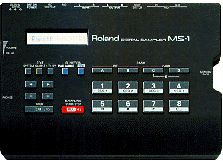
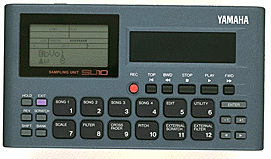
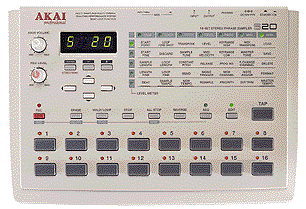
The smallest pocket samplers are: Akai
S20, Boss SP-202, Roland MS1 Yamaha SU10, Yahama SU20, and Zoom
Sampletrak ST-224. However, the newer Yamaha SU 200 is expensive.
In this case I recommand the Yamaha QY700 of the mid range samplers
as bargain issues. The SP-202 has updated to the extended and
more expensive 303- sampler.
For music educational purposes I discovered
that the art of sampling is part of the attractive Disk Jockey
world today. Everyway, this new tool creates a fascinating world
for kids and teenagers but also for adults (you'll see).
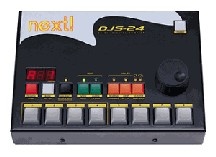
From this music scene I tested (and
bought) the versatile but mostly forgotten handy sampler DJS-24
NEXT! (Amko, Belgium). It's a 24 bit DSP 16 bit sampler and sample-player.
When you connect the NEXT! sampler to a small audiomixer and
mini-hifiboxes, you can use mics, CD-players as sample input.
Connecting the DJS-24 to a computer (PC link= parallel port),
you can even dump samples from your PC to the sampler (internal
memory). Adjust the sensitivity of the sound level without complicated
handling. Till 4 samples of the 8 available buttons can be pressed
and play back at the same time ( a 4-voices polyphony). The memory
capacity to save and keep recorded samples in the machine is
small but handy if you are limited to small CD- or K7 (cassette)
samples. It's more important that pupils can touch the keys physically
and play the sample with their finger than to have only one switch
to store a very long sample or a multisample.
The limitation of storage memory would
be the best way to introduce the basic principes of sampling
and to play selected samples in realtime. DJS-24 includes seamless
looping, pitch control, reverse play mode and scratching (!)
with cue point memory. And that is what all pupils like, from
primary school to music college. Too, the playback of the 8 stored
samples (expandable to 16/32 locations in the DJS-24) can be
programmed in sequences . But I don't recommand this step in
the beginning of the sampling acts. The DJS-24 features good
quality sample-playback and non-destructive editing that means:
you can go back to the earlier point of your sampling. Young
users (pupils) do like the Jingle mode of the NEXT! very much:
the display count down the remaining time of the played sample
in tenths of a second.
In stead of recommanding cut & paste
features, and despite of working with comfortable computer screens,
on a pocket sampler you have to concentrate on the essential:
it's the beginning of the art of sampling.
MusicAnd © P.TIMMERMANS
GO TO THE PRACTICE OF SAMPLING WITH
AUDIO-FILES
GO TO THE ART OF SAMPLING in the Basics-pages