The Practice of Sampling with audio-extracts & sample-links Scroll down
Go to > 
Back to >THE ART OF SAMPLING-page
Sampling (= transferring sound to digits) is something just like with the old taperecorder. The physical pressure of sound is converted to digits in memory and the digital/analog converter at the speaker side transforms the digits again to physical sound. Of course, it isn't quite possible (because it's too expensive) with custom machines to save acoustic sounds in their full lenght into RAM or ROM of the sampler/synthesizer/digital piano. However, the trick is to put only the attack (the beginning phase) of e.g. a trumpet sound in the sample-memory, and to add a good pointed loop if you like to simulate the natural lenght of continued trumpet notes.You have to choose the loop-begin and the loop-end very carefully if you aim to avoid some break in the loop.
Other sampling-problem is qualified reproduction of the same sample (= with typical pitch and timbre) on different points of the keyboard range. Each sample is a cycle of frequency per second. This means, if you play lower on the keyboard, the cycle decreases, or if you play higher notes than the original sampled pitch, the sample isn't usable at all, because the characteristic timbre differs too much from the original. This is called the micky-mouse-effect. An ordinary synthesizersound needs only one sample to cover the whole keyboard-range. On the other side, you cannot play natural sounds outside the range of two-three semi-tones.
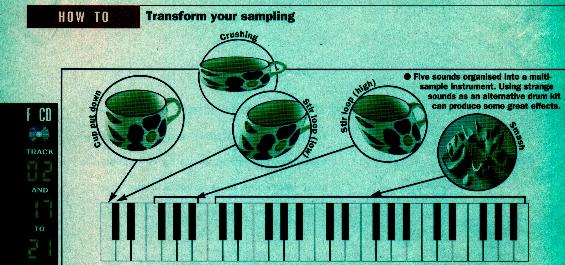
If you like to play authentic sounding intervals with the same sampled sound, especially when simulating acoustic sounds (violin, birds, voice, piano, percussion, etc.), you sample the instrument more than once in different pitches: you allocate these different samples to a specific place in the keyboard range. This arrangement of the same sound within the key range is called a MULTISAMPLE. An authentic acoustic piano-sample needs many single samples (one sample for about 3 semitones!). The best but most expensive way is to reserve one sample for one key. Recently, because computer memory (RAM or ROM) gets cheaper and cheaper, the high qualified sampleboards are equipped with different samples on one key, depending on the pressure, the stick, the reverberation of pp and ff, the"sympathy" with other strings, (for e.g. drumsets or grand piano). The software-samplers used on expensive computers open new technological applications.
Source: Future music July 1994, p.67- 69.
You don't have to wait for the most expensive / the most sofisticated sampler to create interesting music samples.
STORM IN A TEACUP (click>listen to a MP3-excerpt here) was put together using sounds produced from one teacup. The samples are manipulated with a 12-bit Roland W-30 (today's super cheap second hand sampler).
First listen to the raw samples: click> MP3 file
1. Cup put down
2. Spoon stirring (the rhythmical nature of this sample creates the tempo of the piece)
3. Spoon hitting rim
4. Water poured into cup
5. Cup smashed against wall
6. Foot crushing broken pieces
TIPS RECORDING
Record the sound (signal) as loud as possible without distortion. If you record a sound at half its possible level the quality (= resolution) will be halved.
Avoid background noise.
SAMPLING
Go for the highest sampling rate possible.
Due to the incorporated harmonics of a pitch, you double the frequency of the sound you wish to record and you get the sampling rate: actual standard CD quality =44,1 KHz. Compromising the price/ quality rate, most pocket sampler go to 32 KHz, a reasonable level of sound quality.
Remember that the standard pitch A (la) is 440 Hz and that the next A (+1 octave) is sounding at the doubled frequency (880 Hz). Each sound belongs in the range of 20 Hz (lowest) to 20000 Hz (highest) audible frequencies.
LINKS FOR ALL SORTS OF FREE SAMPLES
etc.
I have found "FOUND SOUND" on the Future Music CD (issue november 1996 ). It's sample-based music in techno-style. The trio SPOOKY discovered how the natural and edited samples and instruments are positioned. Listen to a MP3 excerpt> SPOOKY
MusicAnd © P.Timmmermans
to THE ART OF SAMPLING-page
All rights © MusicAnd P.Timmermans Very short audio extracts of STORM IN A TEACUP and SPOOKY are prepared and originate from the Future Music Magazine (issues July 1994 -Teacup and November 1996 - Spooky). They are only used for educational use without commercial purpose. page 3 / 2001 & 1/2005
This page belongs to: http://www.multimania.com/musicand