Please wait while loading pictures and scroll down
Please wait while loading pictures and scroll down
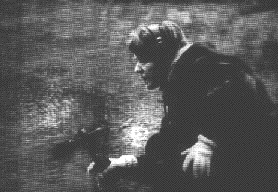
I hear the soundscape as a language with which places and societies express themselves. In the face of rampant noise pollution, I want to be understanding and caring of this 'language' and how it is 'spoken'.
I like to use the microphone the way photographers often use the camera, searching for images, using the zoom to discover what the human eye alone cannot see. I like to position the microphone very close to the tiny, quiet and complex sounds of nature and to make them audible to the numbed urban ear. Perhaps in that way these natural sounds can be understood as occupying an important place in the soundscape and warrant respect and protection. I like walking the edge between the real sound and the processed (transformed) sound. On the one hand I want the listener to recognize the source. On the other hand I am also fascinated with the processing of sound in the studio and making its source essentially unrecognizable. I abstract an original sound only to a certain degree and am not actually interested in blurring its original contours an meanings, similar to the manner in which a caricaturist sharpens the contours and our perception of a person's face. I feel that sounds have their own integrity and need to be treated with agreat deal of care and respect. Why would I process (transform) a cricket's voice but not my daughter's?
Studio 'manipulation' of the sound seemed somehow inappropriate. Its transformation into a composition had to become a new sonic journey of discovery to retain the level of magic first experienced.
A walk through the city (1981) on my CD "Transformations" is an urban environmental composition based on Norbert Ruebsaat's poem of the same name. It takes the listener into a specific urban location - Vancouver's Skid Row area - with its sounds and languages. Traffic, carhorns, brakes, sirenes, aircraft, construction, pinball machines, the throb of trains, human voices, a poem, are its 'musical instruments'. These sounds are used partly as they occur in reality and partly as sound objects altered in the studio. A continuous flux is created between the real and imaginary soundscapes. The human voice (poem spoken by Norbert Ruebsaat) interacts with, comments on, dramatizes, struggles with the sounds and other voices it encounters in the piece. Many of the sounds were taken from the (click>) World Soundscape project's environmental tape collection at Simon Friser University in Vancouver (Canada). Some sounds ware recorded by myself. "
|
Listen to a short MP3 excerpt of (click>) A Walk Through The City (16 '): Hildegard Westerkamp 's CD "Transformations" 1996 empreintes DIGITALes available at: http://www.cam.org/~dim Recommanded: * Hildegard WESTERKAMP: article in "Soundwalking", Sound Heritage 3(4), 1974 * World Forum for Acoustic Ecology (FAE home
page): click> http://interact.uoregon.edu/MediaLit/WFAEHomePage)
+ |
© Hildegard WESTERKAMP
 ATELIER page)
Acoustic
Ecology
ATELIER page)
Acoustic
Ecology TOPIONEERS-index TOMAIN
page
TOPIONEERS-index TOMAIN
pageThis page belongs to: http://www.multimania.com/musicand
