Please wait while loading pictures and scroll down ONLINE ATELIER SOUND TRIP 4

"Sound surrounds us. We are sound inside and we resonate with the soundscape even if we are not listening."
Please wait while loading pictures and scroll down ONLINE ATELIER SOUND TRIP 4 Pauline OLIVEROS (Kingston NY, 1995) "Sound surrounds us. We are sound inside and we resonate with the soundscape even if we are not listening."
Go out and listen. Choose an acoustic environment which in your opinion sets a good base for your environmental compositions ... What kinds of rhythms does it contain, what kinds of pitches, how many continuous sounds, how many and what kinds of discrete sounds, etc. Which sounds can you produce that add to the quality of the environmental music? Create a dialogue and thereby lift the environmental sounds out of their context into the context of your composition, and in turn make your sounds a natural part of the music around you. Is it possible?
Start by listening to the sounds of your body while moving. They are closest to you and establish the first dialogue between you and the environment. If you can hear even the quietest of these sounds you are moving through an environment which is scaled on human proportions. In other words, with your voice or your footsteps for instance, you are "talking" to your environment which then in turn responds by giving your sounds a specific acoustic quality.
Try to move
Without making any sound.
Is it possible?Which is
the quietest sound of your body?(If, however, the sounds you yourself produce are lost in the ambient noise of your surroundings you experience a soundscape which is out of balance. Human proportions have been disregarded here. Not only is your voice inaudible but your ear also is assaulted by a multitude of loud and chaotic noises.)
Lead your ears away from your own sounds and listen to the sounds nearby.
What do you hear? (Make a list)
What else do you hear?
Other people
Nature sounds
Mechanical sounds
How many
ContinuoussoundscontinuoussoundscontinuoussoundscontinuoussoundscontinuoussoundsCan you detect
Interesting rhythms
Regular beats
The highest
The lowest pitch.Do you hear any
I . n . t . e . r . m . i . t . t . e . n . t . o r . d . i . s . c . r . e . t . e . s . o . u . n . d . s
Rustles
Bangs
Swishes
ThudsWhat are the sources of the different sounds?
What else do you hear?
Lead your ears away from these sounds and listen
beyond .... into the distanceWhat is the quietest sound?
What else do you hear?
What else?
What else?
what else?
So far you have isolated sounds from each other and gotten to know them as individual entities. But each one of them is part of a bigger environmental composition. Therefore reassemble them all and listen to them as if you are listening to a piece of music played by many different instruments. Be critical and judge if you like what you hear.Pick out the sounds you like the most and create the ideal soundscape in the context of your present surroundings. What would be its main characteristics? Is it just an idealistic dream or could it be made a reality in our modern society?
© Hildegard WESTERKAMP
GUEST: ANDRA McCARTNEY SOUNDWALK PRACTICE: "Vancouver's Oasis " We maintain a connection with the sound environment by choosing to use fairly long sequences and studio techniques that highlight and trace the contours of sonic gestures rather than isolating sounds from their original context, and radically changing them to make them unrecognizable. I will be including an extensive discussion of studio soundscape work in my CD ROM on Westerkamp.
Soundwalking can also encourage dialogue with the people in a place. Some soundwalkers use unobtrusive microphones that resemble headphones.
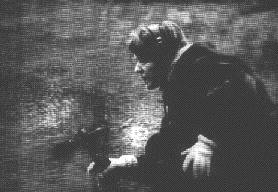
Another interesting level of dialogue is the memories and associations that are inspired by listening to a certain soundscape.Hildi uses a large microphone which is obvious, and seems to encourage people to approach and ask what she is doing. For instance, when we were in the sunken garden, recording the sounds of a large plant, a passerby approached and began to talk to us. After we had recorded the sounds of the young people playing the Knife-Edge sculpture, they also asked what we were doing.
This page documents a soundwalk done in August 1997 by Hildegard Westerkamp and Andra McCartney. Queen Elizabeth Park is a landmark of Vancouver, described in tourist brochures as "Vancouver's oasis", containing Vancouver's only tropical garden under the triodetic dome of the Bloedel Conservatory at the highest point of the park, which provides an excellent view of the city and surrounding mountains. The map of Queen Elizabeth Park is by Hildegard Westerkamp. It was published in her article"Soundwalking" (Sound Heritage 3(4), 1974: 22).
This site can be considered an initial sketch for the introduction to my PhD dissertation, about Hildegard Westerkamp, which will be produced as a CD ROM.There are several places in this soundwalk where Westerkamp's intense listening is evident through the way that she guides the microphone. For instance, at the lookout, she guides the microphone closer to the vent as the airplane crosses overhead, constructing a dialogue between these two very different mechanical sounds. In the sunken garden, she moves the microphone to different points close to the waterfall, revealing percussive rhythms in the water that form interesting polyrhythms with the drumming.
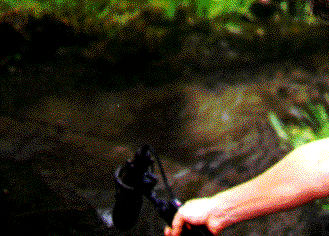
At the creek, she moves very close to the rocks and branches channeling the flow of water, making apparent the changing rhythms, pitches, and timbres that these structures produce.

The waters of the creek sounded very different, depending on how they were flowing. Here the water falls over quite a large boulder. Notice how different this sound is from the following one.
Click and listen >MP3Here, the water is moving more slowly and gurgling around some small branches and stones. It is less noisy and more melodious. You can also hear the air-conditioning from the Conservatory at the top of the hill. This sound seems louder in this part of the park. It continues as we proceed to the Quarry Garden.
© ANDRA McCARTNEY
LINK: ANDRA McCARTNEY's SOUNDWALK homepage (< click)

GO TO PIONEER-page of Hildegard WESTERKAMP to the SOUND TRIPS-index
This page belongs to: http://www.multimania.com/musicand