Flash #1
Click and go to:

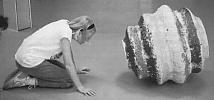
Put your head in the sound vase, and discover the flow of sounds in the hollow on an unconditioned way. Hans OTTE (composer & soundscape designer): Don't manipulate sounds. Let the sound free to fly: the perception of the sounding process is more important for the human being than any compositional intervention, because the Ego of the artist isn't the most important thing. Let sounds develope themselves into the direction they want to go. You have to follow the flow of the sounds, rather than to compose them or to add new events because you don't have to add anything to life. We have to make free the sounds from their connotation or from the human intention. It demands an other kind of awareness, of a new consciousness of sounds on earth. Perception of sounds means: involvement, empathy with the sounds I listen to.
Address of the Sound Installation KLANGHAUS by Hans OTTE: Teerhof 20, D-2800 Bremen 1. (Tuesday-Friday 10-18 / Sa or So 11-18) Addendum Das Buch der Klänge by composer-pianist Hans Otte The Buch der Klänge ( Book of Sounds ) rediscovers a world of consonant experience which could only now be written from a new consciousness of sounds on this earth.
Herbert Henck: "The recording of the Book of Sounds presents a work that is in its way one of the most remarkable creations in contemporary piano music and which has lost none of its beauty, innocence and power in the 20 years since it was written."
Otte (born 1926) began his work on the Buch der Klänge in 1979.
After all the preparation and effort that this retrospective required, Otte felt the need to wipe the slate clean, as it were, and to write new music of irreducible simplicity for his first instrument, the piano. The highly concentrated music that resulted was three years of preparation. Otte toured with the work, as composer-pianist, through many countries and met with a very positive response. Indian singer Pandit Pran Nath hailed the Book of Sounds' essential qualities and likened the work to a prayer. When the music was first broadcast, listeners wrote to attest to its "healing" qualities.
Herbert Henck: "Otte always invoked John Cage as a model in his later years. These requirements were addressed not just to sounds that were traditionally used by and at the disposal of music, but also to everyday sounds... If sounds were given space, if they were given room to breathe and allowed to resound, if they were accepted like other manifestations of nature, then they could begin to reflect the world...and a listener might recognize himself and life in them."The CD package includes 32 page three-language booklet with liner notes by Herbert Henck / ECM © 2002: ecmrecords (< click)
Click and go toREADER
Sounds and Composing (HANS OTTE).
Click and go to NEXT FLASH Music in South Africa (CD-ROM) GO BACK TO GO TO E-mail: MusicAnd (< click) All Rights reserved © Timmermans P.
 auf
DEUTSCH
auf
DEUTSCH