Ad LINKELS (NL) CULTURE CLASH Development education through storytelling songs and dances from the South Pacific

KLIK OP HET VLAGJE VOOR DE
NEDERLANDSE VERSIE

SCROLL DOWN TO BOTTOM: READ THE FULL ILLUSTRATED ARTICLE, AND LISTEN TO MUSIC EXCERPTS Introducing dances and songs from other cultures has a long tradition in the Netherlands. Teachers of music and dance collect songs and dances from all over the world and introduce these to interested people at home. In this way they do not only contribute to increase the dance and song repertoire, but also to a better understanding of other cultures. In our Pacific programmes we have chosen to explain all participants these backgrounds of the songs and dances we are teaching. It is not the easy way.
From the very beginning we introduced the songs and dances we collected as being part of an specific social and cultural system. We never believed in the idea that music and dance are a universal language and that they speak for themselves. It is true that any type of dance or music can be judged indeed by anybody in this world, but only in terms of and based on his or her own culture. If somebody wants to be able to really appreciate the music and dances of say Polynesia, he or she has to know the norms and standards of the culture of origin as well, or at least a bit of it. This is the reason why we explain the functions and background of the songs and dances we are introducing.
At the same time we puposely introduce Polynesian songs and dance as a means of informing about unknown aspects of these cultures on the other side of the world, contrary to the stereotype views existing in Europe: the brown eyed hula girl in a grass skirt and with a coconut bra, dancing on a snow white beach to the music of an ukulele.


Storytelling songs and dances can easily be used as a means of teaching children how people in other places on this earth are living. Actually that is how these songs and dances are also used in many areas, particularly in the South Pacific. Songs and dances tell about history, about what is expected of each family member and inhabitant of a village at a specific age, about natural sources and about natural and other disasters Many of the storytelling songs and dances have proved to be ideal means in development education at primary and secondary schools. Even the young kids really experience what a hurricane may cause when learning to sing the song Lakau O Te Vao (
< click and listen), on the condition that it is explained before:
Lakau o te vao
E tu, kae tu, kae tu
Agi mai te matagi
Siga ki lalo
Ki lalo, ki lalo, ki laloThe palm trees in the plantations
Stood, stood and stood
But if the wind blows fiercely
They will fall down
Down down downIn the song Koko Samoa (
I'm still not used to European cocoa
There is not a bit of cocoa to chew on
Just one cup is quite enough
So I just go on drinking Samoan cocoaThe aroma of Samoan cocoa is great
When it's made by a real Samoan
Pour the beans out onto the tin sheet
Stir with the mid-rib of a coconut frond
Watch carefully to make sure there's no grit.Songs and dances such as these contribute to a better understanding of other cultures, although the confrontation might also lead to controversities or even a minor culture clash now and then. It is usually not the form of the dance or song which causes the problem, but rather its social cultural background. One example. It is very easy to even get boys on the dance floor to participate in a dance called Tangaroa (
Another dance song that is meant to teach a bit of island history to the children is called Mitinikan (
If we could not explain this background to the children in our own classes, we would not teach the dance. Unless we would make a free translation of the lyrics as an alternative to the original; a new version that retains the essence but which makes the song a bit more innocent, like it is is innocent to the children on Rabi. For instance by replacing the word machine gun by "water pistol".
An example of a more light-hearted problem caused during the introduction of a specific Maori haka concerns the lyrics of the chant Hands Come Down (
Hands come down slapping slapping
Feet come down stamping stamping
Hands come up one above the other
If you got a girlfriend hold here tight
But if she spends your money throw her away
One two three four Hi!Some participants of our dance classes felt this was an insult to women. The average Maori men and women will not agree as the song clearely informs about the division of roles and tasks in their culture. So, as we are living in a different culture we have to explain. Or, provide an alternative, which, in this case is pretty easy. As the dancing performers themselves have to sing the song while dancing, they can easily sing a second verse in which the "girlfriend" is replaced by a "boyfriend". It makes everybody happy.

 The
Mundo Etnico programmes include numerous other examples of songs
that may cause controversy when used outside the country of origin.
Songs in which the killing of a cow, Polynesian style, is depicted
may lead to children saying "tormentor of animals".
Until they find out that our spare ribs, minced meat and chicken
wings are also parts of killed animals, but that we don't have
to do the job ourselves. It's normal for the Polynesian villagers
to participate in all aspects of daily life, whereas we, Europeans,
made specialisms out of every single activity.
The
Mundo Etnico programmes include numerous other examples of songs
that may cause controversy when used outside the country of origin.
Songs in which the killing of a cow, Polynesian style, is depicted
may lead to children saying "tormentor of animals".
Until they find out that our spare ribs, minced meat and chicken
wings are also parts of killed animals, but that we don't have
to do the job ourselves. It's normal for the Polynesian villagers
to participate in all aspects of daily life, whereas we, Europeans,
made specialisms out of every single activity.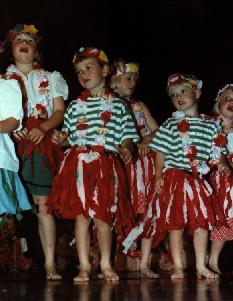 It is easy to collect new and interesting dances
and songs all over the world and introducing the most spectacular
one to other cultures but it is getting harder if you use songs
and dances to paint a portrait of the culture of origin. Using
the songs and dances as a means to another purpose. It takes
time and energy to realise that, but it offers opportunities
to present and discuss differences and similarities between people
and cultures, to view our own values, norms and standards in
a new perspective and to avoid stereotypes.
It is easy to collect new and interesting dances
and songs all over the world and introducing the most spectacular
one to other cultures but it is getting harder if you use songs
and dances to paint a portrait of the culture of origin. Using
the songs and dances as a means to another purpose. It takes
time and energy to realise that, but it offers opportunities
to present and discuss differences and similarities between people
and cultures, to view our own values, norms and standards in
a new perspective and to avoid stereotypes. For
more information visit the Mundo Etnico website:
For
more information visit the Mundo Etnico website: 

 TO
PIONEERS-index
TO
PIONEERS-index