Scroll down and wait while loading pics

Scroll down and wait while loading pics The UPIC System
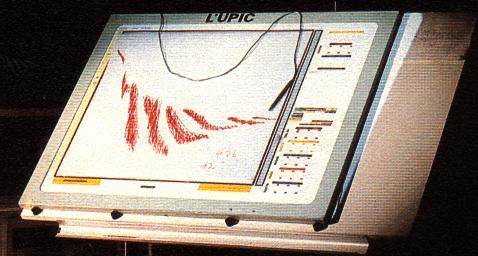
The UPIC is a configuration of a computer linked to a large-size digitizer table (75 by 60 cm) on which the user designs his music using an electromagnetic pencil. At the other end of the UPIC system, the digits are converted into sound through the loudspeakers. Two screens allow the permanent dialogue between man and machine.
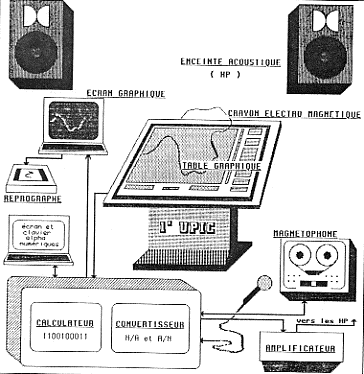
You can use the UPIC system in 4 steps: 1. draw waves; 2. draw envelops; 3. compose a page; 4. mixage.
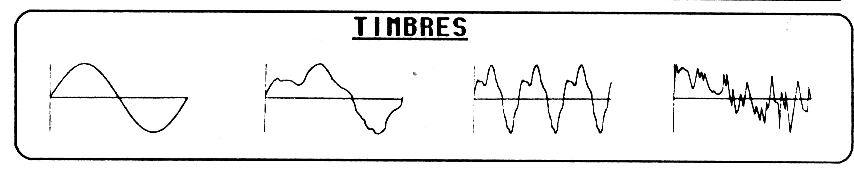
Take the pen, select DRAW on the function menu. Enter the bank of timbres. Draw your desired waveform and then the control screen will show the waveform: you store the waveform in the temporary memory of the computer. Then, select "HEAR" with your pen. Look for a pitch in the drawing area, you hear the sound immediately. Point on another square and after drawing the sound, you will hear a new timbre. About one hundred of timbres can be stored.
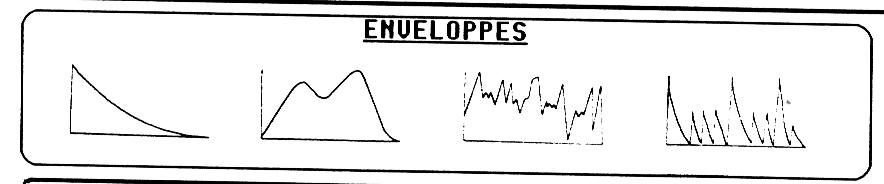
Touch "DRAW ", select an envelop in the ENV- bank. Draw the variation in the sound dynamic in relation to time: the farther your pencil goes from the horizontal line, the louder the sound. Instantly, the envelope is displayed on the control screen; if you aren't satisfied, just draw it again.

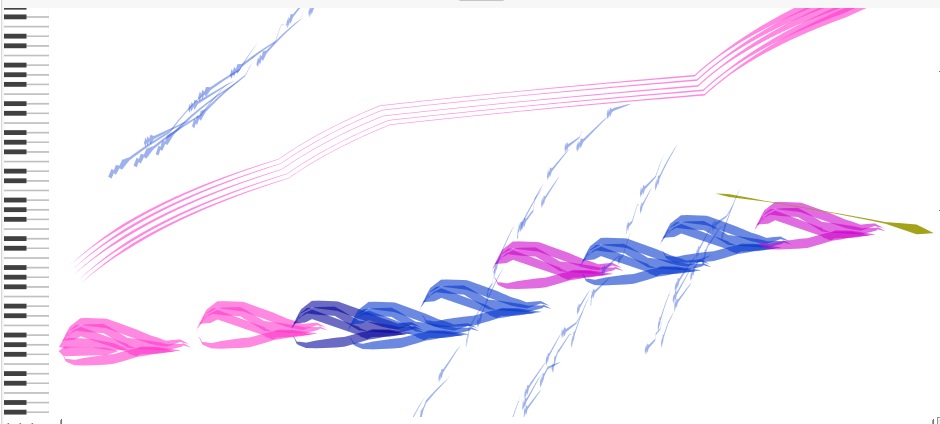
At this point, you are able to draw a PAGE of music, you compose just like a traditional composer but without training or limitation of tuning, conventional orchestral sounds or rhythms. The pitch (low notes, high, up) will be represented on theY- axis in relation to the X- axis on which you read the time read from left to right. At any time you may erase, correct, delete the drawing of a page to listen to a timbre, or to draw a new envelope.
Each new line defines a "sound arc" at which you have allocated a timbre, an envelope and an intensity. Over about 2000 sound arcs are allowed to make. To hear the musical result, you have first to determine the duration of the page (from 1/4 of a second to 1 hour) by pressing on CALCULATE PAGE. In the same way, it's possible to modify the range of your page by AMBITUS: from a semi-tone up to 10 octaves (= Y- axis). Up to 100 different sound waves can be stored.
Selecting "DRAW MIXING SCHEMES" you can mix these sound waves in horizontal or vertical direction, defining the architecture of your piece. The global score will be displayed on the control screen (SHOW WAVE). You can even EXTRACT a new timbre or envelope from that global sound wave.
The UPIC system is controlled by a special set of computer programs which help the user to facilitate his musical choice, without the experience of programming or instrumental skills. The user controls all components of his composing process, from the inner sound structure to the outside architecture of the composition. The program allows to make complex timbres or envelope forms that would be impossible to obtain by freehand drawing.
You can RECORD one or more external samples by converting them in your UPIC system. You can assign a global envelope to your page, make graphic or algorithmic transformations (rotations, symmetries, etc) . Once you have stored the set-up, the UPIC system includes also the modus of REAL TIME playback: when you move, accelerate, or stop your pencil , you can control the interpretation of the score manually. Just like a traditional instrumentalist or conductor.
However, the UPIC-user is able to check and modify the musical result instantly, just like a sculptor. At any moment the UPIC-user can control his composing process. If the gesture is naive, the music will be naive. If the use is elaborated , the UPIC converts the appropriated gesture or manipulation. The composer is also the performer.
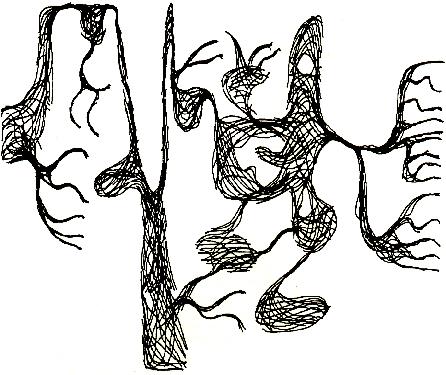
This UPIC-page from Mycènes Alpha (1978) will extend over one minute.
Look and listen http://www.youtube.com/watch?v=yztoaNakKok&feature=player_embedded#!
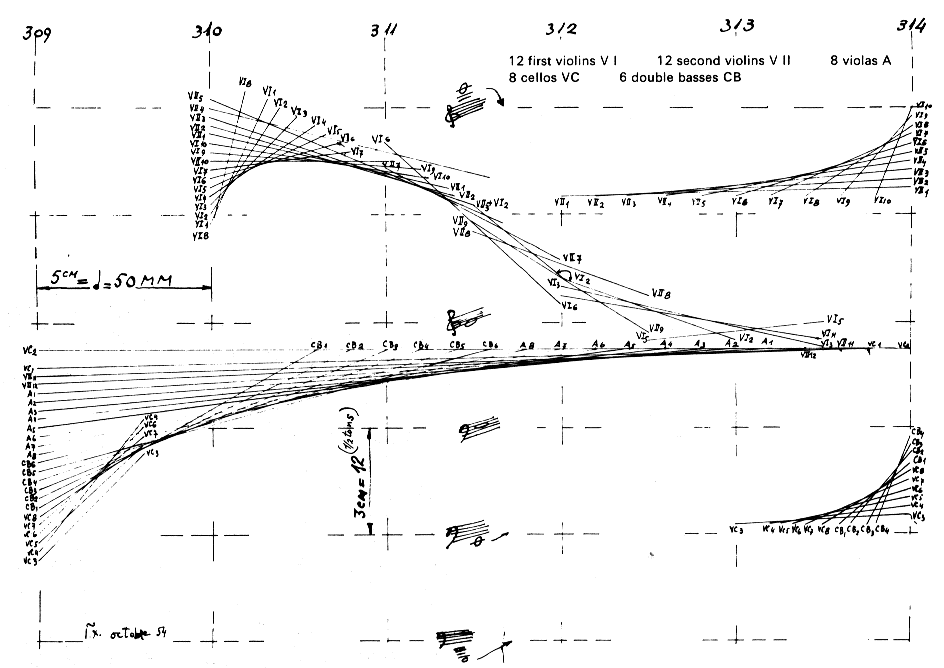
 The original idea
for developping the UPIC, belongs to the Greek composer Iannis
XENAKIS (1922-2001) who wanted to convert the graphical drawings
on his composition METASTASIS (1953) to notes for traditional
performers. Xenakis imaginated a machine to perform graphical
music immediately and to produce the allocated sound waves. Living
in Paris, Xenakis worked 12 years as an engineer with the architect
Le Corbusier. About 25 years later, the Centre d'Etudes de Mathématique
et Automatique Musicales (CEMAMu) in Paris has realized the first
version of the UPIC (Unité Polyagogique Informatique du
CEMAMu). With this tool Xenakis created in 1978 "Mykenae
Alpha".
The original idea
for developping the UPIC, belongs to the Greek composer Iannis
XENAKIS (1922-2001) who wanted to convert the graphical drawings
on his composition METASTASIS (1953) to notes for traditional
performers. Xenakis imaginated a machine to perform graphical
music immediately and to produce the allocated sound waves. Living
in Paris, Xenakis worked 12 years as an engineer with the architect
Le Corbusier. About 25 years later, the Centre d'Etudes de Mathématique
et Automatique Musicales (CEMAMu) in Paris has realized the first
version of the UPIC (Unité Polyagogique Informatique du
CEMAMu). With this tool Xenakis created in 1978 "Mykenae
Alpha".
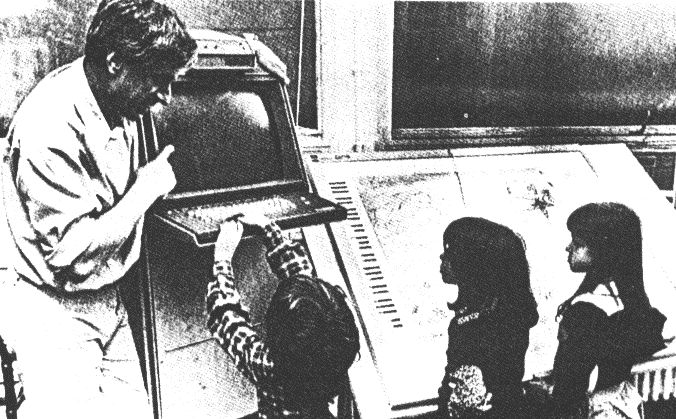
Xenakis didn't want to exclude anybody to "compose" on UPIC, he introduced many groups of dancers, kids, computer minded people, non-musicians ànd composers to the UPIC tool.
"Les Ateliers UPIC" is founded in 1985 as a center for musical creation authorized by the French Ministry of Culture. In the beginning, "Les Ateliers UPIC " has promoted the research at the CEMAMu, especially the UPIC System. Later, the association enlarged its field of activities. Today, "Les Ateliers UPIC" supports the initiation, research, production, musical creativity, workshops, courses, concerts, etc. Since its foundation "Les Ateliers UPIC" has a large number of collaboration with composers, musicians, instrumental ensembles, vocal ensembles, teachers, universities, producers , theaters, opera houses and festivals from all over the world.
Les Ateliers UPIC since 2003: Centre de Création Musicale Iannis Xanakis ( CCMIX)
18, rue Marcelin-Berthelot
94140 Alfortville
FRANCEhttp://www.ccmix.com
HighC is inspired by Iannis Xenakis' UPIC work of the mid 80's. Contrary to most other "audio paint" systems, HighC uses a structured (additive) synthesis model. This allows composing elementary sound objects into higher level elements, and manipulate them symbolically. HighC is the HyperUpic in software for Mac:draw your music. http://highc.org/history.html
MusicAnd © Paul Timmermans
E-mail: MusicAnd(< click) back to the DIGITAL INSTRUMENT-index back to the INSTRUMENT-index back to MAIN PAGE
All rights reserved © MusicAnd P.Timmermans This page belongs to: http://www.multimania.com/musicand