Scroll down. Please wait while loading pictures
Scroll down. Please wait while loading pictures
ACOUSTIC GLASS MUSIC

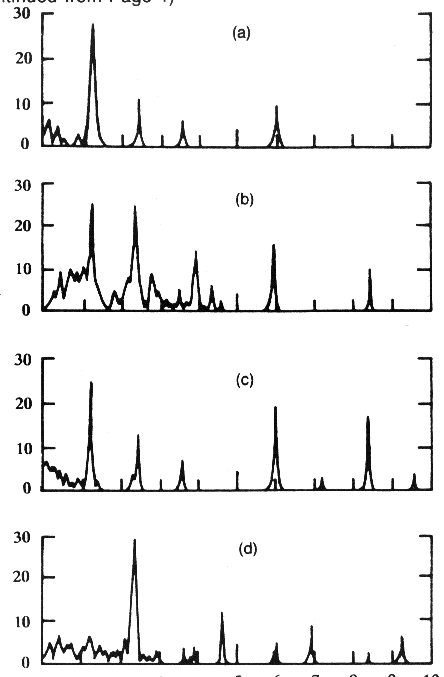
The vibrations of wine glasses can be obtained in three different ways: tapping the glass with a xylophone mallet, rubbing the rime with a moist finger, and bowing it with a violin bow. The fundamental (pitch) is the same in all three cases; the higher partials in the sound spectrum are quite different, not only in amplitude but in frequency as well.
Tapping the glass evokes a number of bell modes.
When we rub a moist finger around the rim, we produce a sound spectrum which features harmonic partials. As the finger moves around the rim of the glass, the sound pulsates with 4-8 beats per second, depending on the speed of the player's finger.
When a wine glass is bowed with a violin bow, the harmonic overtones change during the bowing act.
Finding glasses with similar qualities over a large range of sizes is a problem. Glasses that have a clear and persistent ring when tapped will problaby play well.
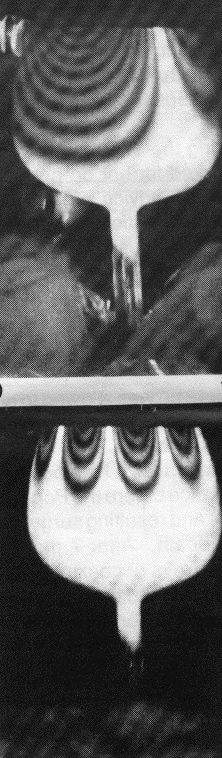
Fine tuning of glasses can be accomplished by adding water or wine, but the range of tuning is small. Filling various glasses half full lower the frequencies up to one semitone or 100 cents. Water affects the playing quality. During a longer performance the liquid level can change. Therefore it would be better to fine-tune the glasses by grinding: grinding down the rim raises the frequency.Holographics of sounding glasses: 1210 Hz (above) and 5900 Hz (under)
Sound spectra of a large brandy snifter (cognac glass): (a) rubbing with a wet finger (b) tapping with a mallet (c) bowing with a violin bow (d) bowing with a violin bow. Y- axis: Relative sound level (dB)
The GLASS MUSIC WORLD Magazine reports about new research on acoustic glass music, performances, festivals, renaissance of products like the Benjamin Franklin Glass Harmonica tables. Contact Glass Music World: 2503 Logan Drive Loveland, Colorado 80538 USA.
GLASS ARMONICA
The glass armonica player has relatively little control over the steady-state sound of a glass armonica, as compared with other instruments. Moving faster increases the level of the sound, but only by 10 decibel or less, unlike the violin player who has acceptable control over loudness by varying the bow speed. The glass armonica player doesn't have the means to add higher harmonics (overtones), a feature that most musical instruments approach by playing crescendos.
Click here on MP3 file and listen to the first seconds of the Rondo for glass armonica by Joseph Aloys Schmittbauer (1718-1809).
German composer and 'Kapellmeister' Schmittbauer was already 43 when Benjamin Franklin invented the glass armonica. However, J.A. Schmittbauer became fascinated by this American invention and expected to increase its range: therefore, he became a builder of glass armonicas. It was one of Schmittbauer 's instruments that the blind armonica virtuoso Mariane Kirchgessner , pupil of him, played for Mozart in 1791.
In Mozart's time, the glass armonica was not an exceptional instrument.
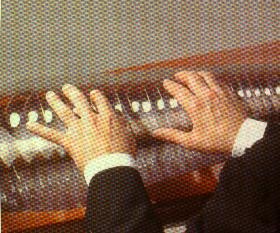
The glass armonica consists of a horizontally nested series of glass bowls attached to a spinning rod and played by wet fingers rubbing the exposed rims.
Dennis James assembled his re-invention of the Franklin armonica in 1991 using artisanal crystal bowls installed in a decorated case.
Glass Music from Mozart's Time CD: Dennis JAMES"Glass Armonica " issued exclusively in the USA via:
Musica Curiosa - Glass Music
3707 5th Avenue, #412
San Diego, CA 92103
619-234-1396 / muscur@aol.comMusicAnd © P.Timmermans
E-mail: MusicAnd(< click) All rights©MusicAnd P.Timmermans This page belongs to: http://www.multimania.com/musicand