ATELIER from "Musica & Arte" Centre, Florence (Italy)


ACTIVE SOUND SPACE FOR CHILDREN FROM 0 TO 99 Scroll down to bottom and wait while loading pictures
The Children's Music
Recreation Center was conceived by Fiorella Cappelli and Stefania
Di Blasio of the Music & Art Study Centre in Florence, and
was realized in collaboration with the Department of Education
of the Municipality of Florence. The multi-sensorical sound space
for children from 0 to 11 as well as to their families, to schools
and unprivileged people, coming from social or sanitary structures.
The facility is open four days in the morning and two days in
the afternoon, the entrance is free (for further information
055 2638600 http://www.musicarte.it).


"Getting there
is not so easy. In order to reach the entrance of the Children's
Music Recreation Center, located in the Borgia Palace, you have
to pass through a maze of narrow streets in the historical centre
of Florence.
When people enter, their faces show wonder at the strange stage
machineries hanging on the walls of the first room,
at the pipes and hand-bells coming down of the ceiling, and at
all the kinds of objects which can be found on the carpet.
Hesitation only lasts a short time, a child's foot trips over
an object, adults bumps their heads into the hand-bells, hanging
from the ceiling and it is immediately a party: the sound is
bright, like the smiles on the faces.
The magic of the sound easily catches the adults and children's
attention, who are all engrossed, almost without realizing it,
in the pleasure of "seeing, touching and playing" with
all those objects. On beginning the tour, the emotional strain
of discovering becomes evident, in the typical attitude of spontaneous
learning.
The operators follow everyone's initiatives, amusingly wondering
who is really the youngest among those present in front of the
sound experience: a child identifies the cranks of a strange
mechanic carillon and draws the adult's attention on their working;
later on, it's the adult's turn to show the child the raft psaltery,
hanging vertically from the wall. They both do not dare getting
closer to this wonderful instrument and with their eyes, without
a word, they ask the operators: "where's the secret?"
With noteworthy attention, they try to plan their actions, in
order to listen to the sound: while one plucks the strings, the
other moves the ponticello.
Before the strange pipe-phone, going up and down the walls, almost
everybody is wrong-footed: the operators intervene, in order
to show them how to send remote secret messages.
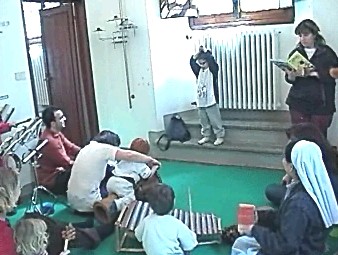
In the second room the game can go on with the
discovery of disarmingly immediate ethnic instruments:
African dances, marimbas, slit drums, harness bells made with
goat nails, and so on.
The marimbas are brushed, and the slit drums are played with
great joy.
Some instruments inspire respect, others invite to action. Their
sound is sometimes perceived with great astonishment, or, other
times it is recognized. In the hustle and bustle, between an
acoustic effect and another, nobody suggests what to do: children
follows the grown-ups, or the other way around, and the operators
follow them all, in order to help them convert every fit of curiosity
into action, and every action into a sound. As in every real
game, there's no aim nor goal in playing, observing and listening
to so many musical instruments.
While the children and the adults incessantly continue their
free exploration, the operators observe and
launch operative ideas. Nobody explains (if not upon request),
the way the sounds change tone-color, or how and why the drums
change pitch: in the Children's Music Recreational Center, sounds
are lived and not thought.
In this second room it is possible to concentrate on more contemplative
activities, such as browsing musical books or listening to music.
But contemplation time, at a certain moment, makes room for the
sound puppet show.
During this performance it is possible to watch a show in the
show: fascinated by the small stage children are not happy with
the simple listening of the sound story, so they asks to perform
themselves.

A third room, the last one, opens up to
the visitors: the presence of a computer laboratory and
a carpet, make people imagine serious activities taking place
here. The surprise is lurking, and it is sensational. Every step
taken on the carpet fills the room with sound cascades;
by shuffling your feet, unknown atmospheres explode, and jumps
cause some different clusters.
Children, at this point, try all kinds of body contact with
the carpet (a real match), and while crawling on all fours,
rolling and more, they listen carefully to the resulting sound
successions. Instinctively, they perceive the relation
between their movements in time and sound; they play to provoke
acoustic combinations, always different from one to another,
operating on the factors which determine them.
Not only spontaneous game programmes work in the software laboratory;
on the contrary, a wide range of music software is arranged
to create collective learning pathways (integrating live education)
as well as individual self-learning for children and adults.
This Children's Music recreation Center is a magic place, come
and see it!"
FIORELLA CAPPELLI©

FOR MORE DETAILS: GO TO
FLASH #3: FLORENCE's Music Educational Innovations
F. CAPPELLI La Ludoteca musicale: un habitat misterioso e un prezioso osservatorio (The Children's Music Recreation Center: a mysterious habitat and a precious observatory", in "4e40", 1, VII, January-April 2002, pages 28-30.
SOUND TRIP- ATELIER
indexGo to the to the ATELIER - index